
Two Titles
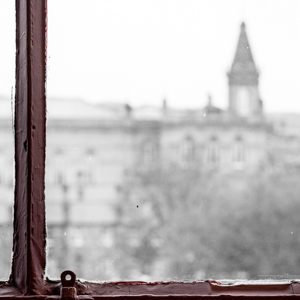
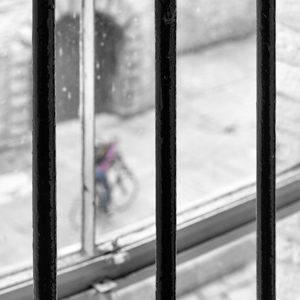
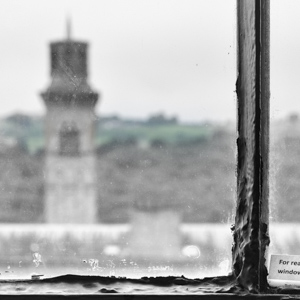
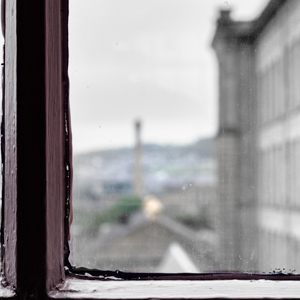
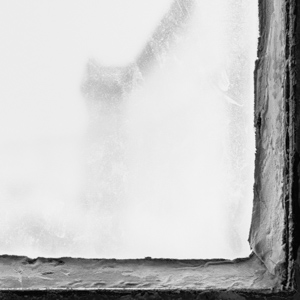
This group of images engender two different feelings in me – hence the name, ‘Two Titles’.
They're taken from inside Salts Mill, looking out.
Read more about them HERE …
About This Gallery of Images
Originally built in 1853, Titus Salt’s textile mill is now an art gallery so it’s somewhere we often visit. And each time, there’s a point when I catch sight of the outside world, the world beyond the window – Shipley Parish Church perhaps, or the surrounding hills – and I begin to think about working there, over a century ago.
Conditions for mill workers in nearby Bradford were appalling at that time. A quick Google search shows life expectancy in the city was one of the lowest in the country; after visiting, the writer George Weerth said “you think you have been lodged with the devil incarnate. If anyone wants to feel how a poor sinner is tormented in Purgatory, let him travel to Bradford.” And so Salt’s new mill and new town (Saltaire) – built 3 miles away, in a location which a newspaper described as “romantic, rural and beautiful” – are lauded for improved living conditions (clean water, sanitation) and improved working conditions (quieter machinery, with its drive shafts underfloor; flues to remove dirt and dust; low pollution smoke-burners).
But there’s still a part of me which wonders whether Salt was a good, benevolent employer, or just less worse? And similarly, even if noise, dust and pollution were lessened, whether the factory was a good one, or just less worse? A 10-12 hour working day, in the humid conditions needed for textile production, surrounded by dangerous machinery, young children working alongside, all this remains stubbornly beyond my imagination.
And now that the village feels gentrified (as the image alongside), made a UNESCO World Heritage Site and the mill is a gallery – dust-free and odourless, complete with cafés and shops – there’s little hope of a really close emotional connection. But a part of me has connected well enough, a very large part of me in fact, to give thanks that I was born 100 years later; for the NHS, obviously; state education available from 5-22; a professional career; the right to vote, to own property, to have a bank account; the freedom to travel.
Plenty to give thanks for.
So that’s my first response to these images – I’ve an empathetic awareness of the past, but largely it’s intellectual curiosity, a cerebral understanding; I’m reacting with my head, as my use of Google underlines.
The second response is, however, markedly different – I’m reacting with my heart; the title would be more emotional, more emotive; it’s related to the sense of difference which Catherine Woodiwiss identifies when she writes that:
“trauma permanently changes us; there is no such thing as ‘getting over it’. There is no ‘back to the old me’. You are different now, full stop”.
For us it’s been medical trauma from events in the far distant past, but any painful episode will, I’m sure, have the same, or similar, effects.
Ms. Woodiwiss isn’t negative or despondent – she talks about healing and “wearing your new life with courage” – but it isn’t a linear process, perhaps (as we’ve found) because one has changed, and is trying to heal, whilst the rest of the world steps onwards, totally unaffected. And some days the dissonance between me and the world can feel so great that normal reintegration is unimaginable. One is distanced, remote – Barbara Castle describes it as being behind a curtain but, for me, it’s perfectly described by this gallery of images; like looking out through a dirty window, unable to see the world as clearly as it used to be. Normality, or anything close, is an unachievable, unimaginable dream.
Thankfully, this feeling is now rare and it’s easier to ‘wear my new life’ – the passage of time has helped although it doesn’t ensure I feel 100% healed, 100% of the time, despite decades passing by. The footprint of the memories never fully fades, and recent weeks have shown that I can be thrown back 40 years in an instant – by being minded of someone’s words, a phrase, uneasy action.
But, once again, my photography is helping to restore, to heal, rebalance – #Art for Recovery – firstly, by putting a ‘face’ to this feeling of isolation (through this gallery of images) and thereby making this separation explicit. It’s now clearer (and easier) for me to identify the times when the footprints are heaviest, the isolation greatest, and distinguish them from the good times when ‘normality’ is feasible; easier to accept the ‘before’ times were the bad times; easier to put down their weight and let go; easier to move forward, keep moving forward, to the ‘after’ times, some good times – to embrace my new life.
Quoting Ms. Woodiwiss again:
“In the end, the hope of life after trauma is simply that you have life after trauma.”
Postscript:
This poem, remembered from my childhood, has sat in my mind’s ear whenever I’ve been working on these images.
I can't explain why – simply because I'm not sure myself.
I’m sitting on the doorstep,
And I’m eating bread and jam,
And I ain’t a-crying really,
Though I ‘specks you think I am.
I’m feeling rather lonely,
And I don’t know what to do,
‘Cos there’s no one here to play with,
And I’ve broke my hoop in two.
I can hear the children playing,
But they sez they don’t want me.
‘Cos my legs are rather little,
And I run so slow, you see.
So, I’m sitting on the doorstep,
And I’m eating bread and jam,
And I ain’t a-crying really,
Though it feels as if I am.The Littlest One
Marion St John Webb (1914)Take care of yourself
Paddy