
Do I want to be an artist instead?
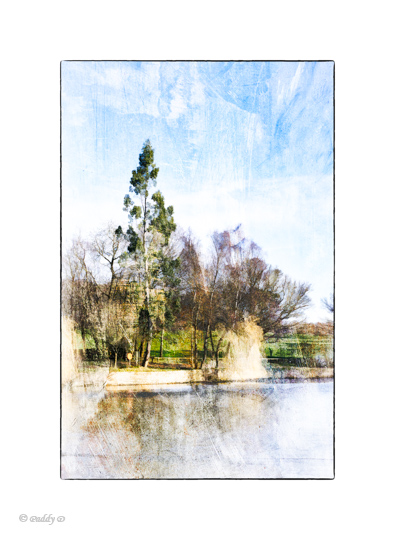
Untitled
Asking myself ‘what has my fine art photography ever done for me?’ has started me thinking.
Do I want to be a proper artist – a painter-artist I mean, rather than an art-photographer?
I did my first course on the History of Art in 2011 (I’ve done four more since then) with the specific aim of informing my photography. And, as a direct consequence, we’ve visited a lot of art galleries, seen more and more artworks; I’ve met local artists Helen Thomas, David Lyon and Tony Wade, and done an artist-led workshop with each of them; I've exhibited my work alongside professional artists in Ripon Cathedral. And the more I encounter art, the more I envy artists.
They start with a clean, clear blank-canvas and can imbue their work with the rich record of their experience, weave it into the layers of their work as their painting develops – they can incorporate their emotional mood and physical feelings as well as the ‘story’ they’re telling. But my experience as a photographer is very different; the starting point for me is the camera – a device which, oft times, behaves like a tyrant – arrogant and dictatorial.
To start with it captures too much detail – far more than I can ever see (even with my glasses on!!) – so much detail, in fact, that I’m unnerved by the knowledge that there’s a world out there I failed to see. And the precision and detail are at variance with my world-view – that the world I do know (and can see) is inexact, imperfect. Searching for a metaphor, I’m minded of pressure surges in pipelines. I spent a career analysing, predicting, computing pressure-waves in pipelines – to the extent I could visualise them when we were on-site – interpret what I was hearing. And, even when the initial flow change was very abrupt, that initial sharp-fronted pressure-wave never stayed ‘sharp’ for long. It was soon attenuated and softened, by friction, by air bubbles, by pre-existing transients.
Even as I’m typing I can see it, see the exact type of wave I mean – I can see it decaying.
It seems to me, that ‘life’ is like that too – messy! It may start out precise and controlled but it’s soon ‘attenuated’ by reality – by people, by events, by all the things outwith my control. And, whilst that’s my view, it’s not one shared by my camera! So, when I’m processing an image, I disturb the camera’s precision and exactitude, instating my view. The image remains representational – it’s not as abstract as a Jackson Pollock, I grant you – but it’s softer, no longer possible to count the leaves on a tree, or every brick in a wall. And all the time, I’m envying the artists their licence to add as much or as little detail as they wish.
Then, not content with capturing too many things – the camera captures all the ‘wrong’ things too! Well, not ‘wrong’ in the sense of what’s in front of it but ‘wrong’ in the sense that it doesn’t see all the things that I saw, in the same way I saw them – particularly the sudden movements which catch my attention. In the world of the camera, the running child, the soaring bird, the leaping dog become transfixed, immobile as pillars of salt.
By this stage, you’ll not be surprised to know that the camera and I differ in our view on colour too, so that I envy artists their colour palette – the purples they see in shadows, and the yellows, the reds, the blues – whereas the only colour my camera seems to capture (at this time of year, anyway) is green. Innumerable greens, I grant you, different shades and tints (as many as a digital device can manage) but they’re all green. It’s a faithful record and, when I’m walking through the woods, it’s the perfect colour – soothing, calming, peaceful, with the optimism of new growth. But, when I’m back home and looking at the images, ‘just green’ seems to sell the woodland short; it’s too flat and overbearing, smothering and oppressive like over-laden branches. I want to speak a different colour-language (like a painter); primary colours to tell the tale of being there – the joyousness, the lighter step, a moment’s carefree pleasure.
I’m turning into David Hockney!
Then there are all the things which I experience – the sound of birdsong, of laughter, the light touch of the breeze, Ian’s companionship – important to me, unnoticed by the camera. I've experienced one multi-sensory life whilst my camera ‘lives’ another, a singular one!
And I envy the artists who continue to work ‘en plein air’ till their painting is complete whilst my work only starts when I’m on-location – that’s just the first stage. There’s an intermission once the photograph is captured and I journey home to recommence the second stage – downloading the photographs from the camera, reviewing, processing, and printing them. But, in that interlude, the visual scene has changed, the engagement’s lost its magic and I need to rebuild the relationship from memory. If only I could do it all on-site, like an artist!
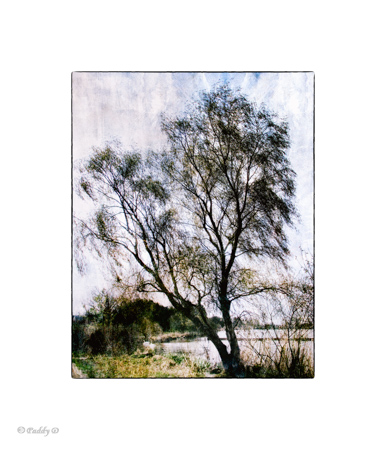
Untitled
I've given you a lot of reasons why the camera can frustrate me; and a lot of reasons why I envy artists. I’m not surprised that photographers take to painting – Isabel Curdes, Valerie Dalling and Doug Chinnery among them. Is it time for me to join them? I did a course of drawing a few years ago and a painting workshop earlier this year. Should I do more? Should I commit to painting and put my cameras on eBay? Certainly, the case feels convincing.
But then a voice pipes up in the mind’s ear and starts to rally support for the camera.
I think of all the camera-walks we take; they’re like a visual GPS record which means that I can re‑enjoy them without leaving home, retrace the walk, re-experience the pleasure. And I don’t have to struggle with the constantly changing weather and light (as an artist does) when working out of doors. Maybe things aren’t quite so bad.
And the clinching argument is, I think, that I can turn that two-stage photographic process to my advantage – that’s where art-photography comes to the fore. It gives me the best of both worlds; using the camera for what it’s best at and inter-weaving my ideas at a later stage.
Yes. Fine art photography – that’s what it all boils down to, for me – the opportunities, excitements, challenges, engagement, immersion, joy it affords. As I've explained, my dissatisfaction with the camera’s role in ‘regular’ photography is extensive – and, I’m guessing, the limitations are sadly insurmountable now in my mind – but all this is swept away by art-photography. And here, there’s so much more for me to learn, to explore, discover; I’m just scratching the surface.
So no. I don’t want to become a painter-artist.
Not yet, anyway!
Take care
Paddy
P.S. Re-reading this finished text to myself, I've had the strangest feeling that there’s another question in the wings, ‘how does art help me understand myself?’