
My Rosetta Stone
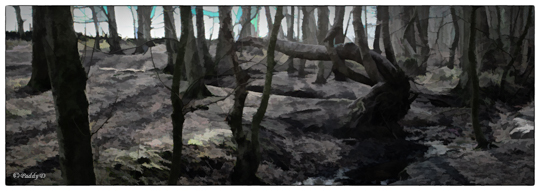
Lest We Forget
Breary Marsh, Leeds 2019
with British War Art in mind, France 1914-18
Many of the woodland images you'll see on this website were experimental, produced as I tried to represent the way my senses responded when we walked through the trees – my sense of the light, of the textures beneath our feet, of the smells and sounds – collectively they’re my impressions of the walks. But this image is different; it’s about mood and memory; it's my Rosetta Stone. In the same way that the real Rosetta Stone provided a link between Egyptian and Greek texts and the key to deciphering hieroglyphs, this image is a key for me; it creates a link between ‘vision’ and ‘interpretation’ and with it a traversable bridge into my new art world.
Unexpectedly, one of the first difficulties I’d encountered as I made the transition from engineering, through photography and on towards art was in learning and understanding the vocabulary and concepts (unexpected because, after all, art is a visual, non-verbal medium!) – the biggest hurdle being ‘artistic vision.’ This was a stumbling block of such incomprehensible enormity I was sure I’d remain, forever, as a technical photographer, never an artistic one.
At first I only understood ‘vision’ in terms of visual acuity, particularly pre/post cataract interventions (a lot clearer now, thank you for asking). Then I progressed (if progression is the right word) to the more business-like definition of ‘aims and objectives’; then to ‘purpose’ or ‘intent’; but the breakthrough came with this image because it enabled me to understand ‘artistic vision’ as ‘interpretation’.
It works in other media too; understanding that the much-loved 60s classic we heard being slaughtered recently was someone’s vision – their interpretation. And in turn (and more importantly) this aligns fully with Ansel Adam’s belief that the photographic-negative is comparable to the musical score, the print to the performance.
Maybe my working definition of ‘artistic vision’ will progress further in the future but for now, at least, it’s something I can work with – something which allows me to proceed more confidently and to put aside the despairing, self-imposed title of ‘technical photographer.’
So now returning to this image …
Looking at the other photographs I took on the same day, on the same walk – on that blue-sky, February morning – you can see the silhouettes of trees, captured contre-jour; shapes and shadows; reflections on the water in Peter’s Pond; all re-creating our upbeat and jaunty mood. Yet, when we stood at this edge of the wood, our experience changed; we both saw a very different scene – unexpected but familiar; a scene that we both recognised from 1914-18 war art – a shattered tree stump, a fallen tree, a ditch, perhaps a trench; a scene which was strangely detached from reality and the outskirts of Leeds in 2019.
Asking myself why we’d made this connection so strongly, the answer was very different for the two of us; for Ian the trigger was a letter, newly seen, written by his grandfather in 1915 from Hill 60, Ypres, describing it as “hell with the lid off”; whereas I was minded of the ‘Truth and Memory’ exhibition we’d seen on 1914-18 British War Art in York Art Gallery, perhaps because that had an air of unexpected familiarity as well.
I remembering standing in front of paintings which I knew well in reproduction but this knowledge still left me unprepared for the way their size overwhelmed and seemed to envelope me; unprepared for the emotion of this immersive experience; standing alongside the life-size Scottish soldier in the foreground of Robert Jack’s painting, ‘The Return to the Front: Victoria Railway Station’, evoking photographs of my own kilted grandfather; almost touching the raw desolation around us in Spencer’s works and Nevinson, for example. Unexpected familiarity.
And I knew that, of all the possible ways I could represent that walk, it was this scene – interpreted in the style of British War Art – which was important to me. Thus ‘Gassed’ by John Singer Sargent directed the shape in which I cropped the image; the haunting work of John Nash and Paul directed its level of simplification and abstraction.
In turn, this image feels like a personal Rosetta Stone.
I've only created two versions of it – not three like the original Greek/Egyptian/hieroglyph stone – but two versions are enough. The first, the original captured by the camera, gives a literal view whilst the second is an interpretation; it’s my view – it embraces mood, memory, sensation, knowledge – it’s my artistic vision.
And it’s my bridge into a new artistic world.
Take care
Paddy
December 2019