
Our Industrial Landscape: St. Aidan's
St Aidan’s Nature Reserve is a magical place.
It’s only 10 miles from here, located in an unprepossessing triangle of roads – the M1, the A1 and the M62. But it’s like stepping through the wardrobe into Narnia – without the threat of meeting the White Witch or being offered Turkish Delight! Suddenly you’re in a world of owls and bitterns, of gulls, skylarks and harriers; reedbeds, wetlands, meadows and woodland.
I know I’ll tell you more about this delightful piece of countryside sometime soon – show you images which will share my impressions, our pleasure in being there. But this image deals with the back-story because, in its former life, St. Aidan’s was an open-cast coal mine.
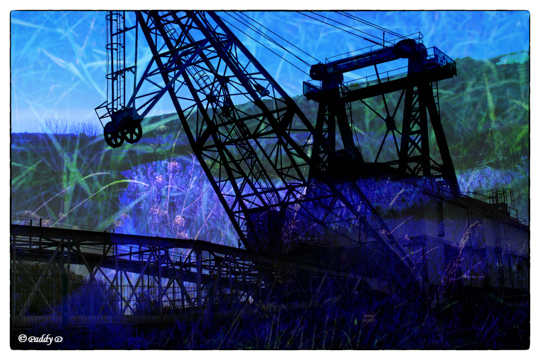
One impression of the large walking dragline excavator, known as Oddball
Today nature has reasserted itself, reclaiming a redundant part of our industrial heritage – our industrial landscape – in a beautiful, positive way. But, despite this, there’s a bit of that industrial past which seems to follow me around the site, wherever I am – follow me figuratively, rather than literally, I hasten to add – and that’s the large walking dragline excavator (over 1000 tons of it) known as ‘Oddball’. It sits up on the hill and is the first thing to greet you – in a 1000 tons kind of way! – as you drive into the carpark.
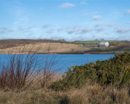 Perhaps it would be different if we walked to St. Aidan’s – came down along the River Aire from the city centre, crossed one of the little bridges and entered from the south. Then, as you can see (alongside), Oddball is ‘fiddling and small’ – visually quiet, nestled into the hillside.
But we don’t.
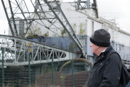 We drive into the carpark and then walk past it. And it looms over us.
It dominates the space around it; completely fills one’s vision, in a mesmerising way.
It doesn’t feel threatening although I feel it should – well not threatening to us, least ways. Mostly it’s a benign presence; I can pass it with that strange, slightly distant curiosity that I sometimes have when seeing a dead bird in the woodland. But other times I seem to sense something very different, something much darker – an echo of its violent past; as if the memory of the damaged land is crying out beneath us, if only we stopped to listen properly.
Soon I’ll select a gallery of images which shares the magic with you – magic which inspired us to install a bird feeder in the garden and plant more bulbs in the grass. But first I need to tackle the ‘industrial’ side of this industrial landscape – both the visual footprint of Oddball which seems to follow me around and my contradictory reactions.
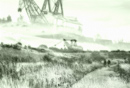 And it’s that former point – Oddball’s visual footprint – which the image alongside addresses; it started as a ‘normal’ photograph of a couple walking up the hill, with the excavator ahead of them. Then I applied a simple photographic technique in which an enlarged section containing Oddball was overlain on the ‘normal’ version and the two layers were blended together. Then, to emphasise Oddball’s ‘benign presence’, I made the image light, bright – a bit dreamlike.
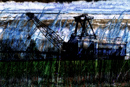 Next I worked on the main image at the top of this page and the one alongside – images which reflect the other face of Oddball; both use the same overlay technique but there the similarity with the dream-image ends. Each one combines several layers – Oddball, reeds beds, water channels and local flora – blended to emphasise the darkness and intensity which prompted my sense that the ‘damaged land is sometimes crying out beneath us’.
So now that I've acknowledged the past fully, I hope I can enjoy the present better.
Take care
Paddy
February 2020