
Making a Start
I've made a start on this new project by looking through my back-catalogue at earlier work and I've picked out my series on effigies because these are the types of image which truly make my heart sing. They forego any emphasis on architecture in favour of a sensitive depiction of people in the past – the way they're presented, their humanity and feelings.
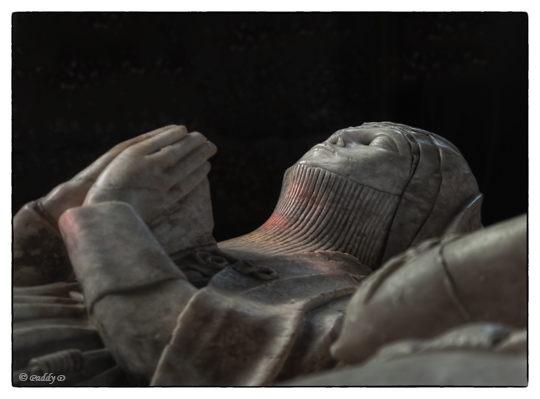
Effigy of Margaret Clarell in Harewood Church, Leeds
from the series 'Ian's Mates: People Like Us'
It's strangely awkward trying to photograph an effigy.
It's easy enough if you just want a general impression (as the image below) or if you simply view the effigy as an historical artefact – using a livery collar to provide evidence of affinity, for example, or the tomb chest as evidence for the number of sons and daughters. You can snap away in whatever manner best represents the task. But it becomes more complex if you view the effigy as a person – not as 'it' but as someone's partner, parent, offspring, friend. Then you're battling with the geometry, the angles, alignment, physicality of the situation – because there are few occasions in life when one is standing, in communication with someone who's lying flat on their back, about three feet off the ground (sadly one occasion is hospital visiting).
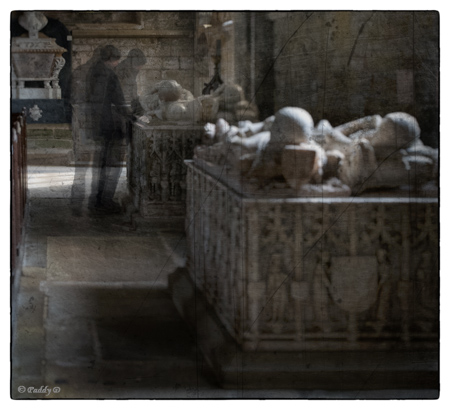
Ian 'talking' with Lord Chief Justice Sir William Gascoigne
So this will be the opening theme, allowing me to introduce you to people like Margaret Clarell. Maybe you've met her already – she's a neighbour of mine. She lives just up the road from us – well, more accurately, she lived up the road, some 600 years ago – at Gawthorpe Hall (near to Harewood Castle) with her husband Sir William Gascoigne.
If you stand in Harewood Church and listen to Ian talking about her, or about Edward Redmayn and his wife Elizabeth, or any of the other pairs of effigies nearby, you'd swear he was talking about old friends – people he'd met for coffee, only last week. And maybe that's an idea I can pursue in my new project. Maybe I can find a fresh, expressive way of representing Ian's relationship and respect for his 'mates' – and not simply concentrate on the effigies alone.