
Dam Square, Amsterdam
Photography differs from other forms of creative expression in that you have to be there – you can’t do it from imagination alone.
Ok. I’m sure you can think of exceptions but, in the main, a painter can choose to work from memory, a musician’s composition is in their mind and, as Ian points out, an historical novelist has no choice. But the photographer, the camera and the subject have to be in the same place, at the same time. And this means that the photographer is uniquely placed to engage with the living, breathing space around them while the photographic process is taking place.
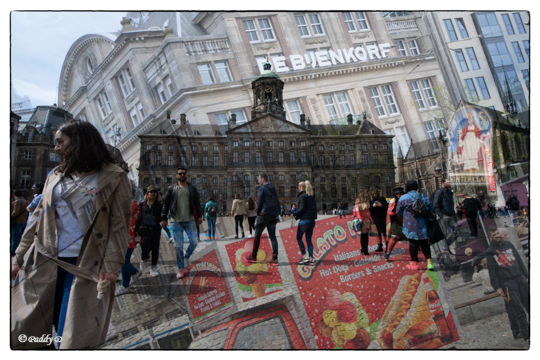
Dam Square – a living, lively, breathing space
The Royal Palace forms the backdrop
And this image shows you everything I experienced in Dam Square – it’s a perfect representation of the way I’d talk to you about it; about the vitality of the square; the people; the buildings; The Royal Palace as a backdrop. Ice cream vans; de Nieuwe Kerk; the stone tablet on the wall to Sinter Claes; and then behind me, street performers and the National Monument.
Movement and energy; hustle and bustle; comfortable, un-threatening (but slightly edgy) chaos.
Ok, largely un-threatening because, real or imagined, I swear there was a fire-eater behind me.
But it hadn’t been my intention to create an image like this, when I arrived at the square. I knew a bit about the history of The Royal Palace, and I’d imagined taking a photograph which would respect the formality and tradition of the building. I’d planned to use the Long Exposure technique because it can simplify the scene – make it more orderly and remove the distractions; I’d had the idea that it would allow me to focus visually on The Palace.
You can read more about Long Exposure photography [ HERE … ]
Usually I enjoy Long Exposure; calmly waiting – ‘standing and staring’ – while the camera’s busy. But, on this occasion, my experience was the polar opposite; it wasn’t a soothing, mindful, meditative time; my breathing didn’t slow. Instead I guarded my tripod from clumsy passers-by; I watched the street performers; thought about ice cream; considered Sinter Claes.
That was the reality; that was my experience.
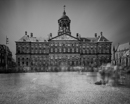 And I didn’t feel any Long Exposure magic when I worked on the image alongside some weeks later; instead I felt aloof, detached, remote – completing it because I ought, not because I wanted to share it with you.
I think you can tell which of the images gives me more pleasure, just by looking at the layout of this page.
Arguably, the historic Long Exposure view has the potential to be the stronger photograph (if I completed it properly). But, for me, the other one is better – the one which captured the living, lively, breathing space which I was part of; that’s the one which communicates the better story – my story.
And, in turn, I know I've reached another milestone on my photographic journey:
• firstly, learning that the emotional engagement of the photographer is, at least, as valuable as their technical ability (and possibly more so!)
• secondly, understanding it’s impossible to predict how you’ll feel until you get there – the atmosphere and experience may demand a very different game-plan from the one devised in advance.
Take care
Paddy
December 2019