
Looking Back (III)
Connecting with my Photographic Forebears
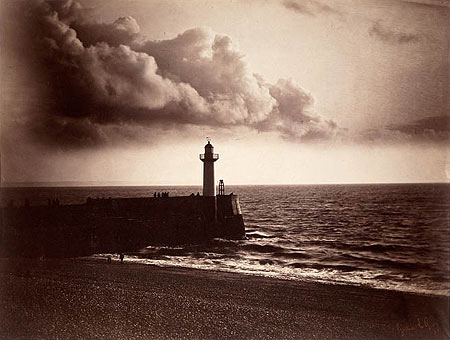
The Lighthouse and Jetty at Le Havre
Seascape by Gustave le Gray, 1856/7
It’s one of life’s self-evident truths that you can only photograph what you see. One’s photographic view directly reflects the places you go, the things you see, the things you consider ‘picture-worthy’, the things that make you smile, that engage you. And this knowledge (that you can only photograph what you see) helps me connect with all the photographers before me. Because we’re all doing the same thing, for broadly similar reasons – and have been doing so for almost 200 years. Both amateur photographers like me – and the most famous photographic names – we all do the same. We photograph our friends, our families, our favourite places, the view from our windows, the view in the street.
As I wrote earlier [ HERE … ], Roger Fenton took a photo of the parterre at Harewood House in 1859 – just like me.
Julia Margaret Cameron took photos of her friends – just like me (though in her case the list of friends is slightly more eminent, including Alfred, Lord Tennyson and Sir John Herschel).
In 1892, Alfred Stieglitz recorded a street-scene in a photo called The Terminal – just like me – except his scene included a horse-drawn streetcar, mine contemporary London traffic.
Gustave le Gray took seascapes – just like me. (That’s one of his photos at the top of this piece, and one of mine below). Could he have enjoyed the Northumbrian coastline we enjoy, as much as the Mediterranean and Normandy coasts he normally frequented?
And in America, William Henry Jackson photographed the ‘wild’ west – just like me. He was part of the US Geological Survey of the Territories, exploring the wilds of Colorado, Mexico, Montana, Utah, and Wyoming. I was simply a tourist on Hadrian’s Wall!
Now that’s just the tip of the iceberg in the history of photography – but what better way to connect with, and understand, my photographic forebears.
Me Being 'Just Like Them'
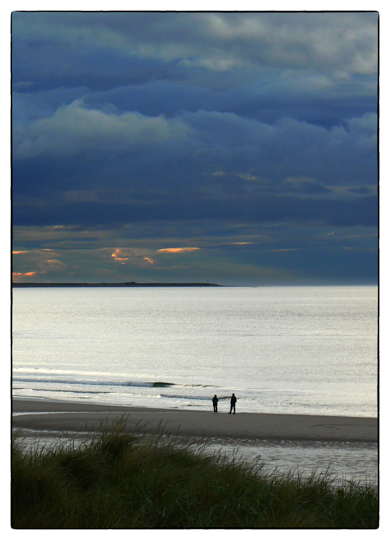
The Beach at Bamburgh
Seascape by me (2008), using a technique by Gustave le Gray
It's always difficult to create a pleasing, credible, well-balanced image when one part of it is a lot brighter than the rest – the technical limitations of most cameras mean that they're not as versatile as us, with the amazing capabilities of our own eyes. But it's always been like this. Quoting the Victoria and Albert Museum:
Most photographers found it impossible to achieve proper exposure for both landscape and sky in a single picture. This usually meant sacrificing the sky, which was then over-exposed. Le Gray’s innovation was to print some of the seascapes from two separate negatives – one exposed for the sea, the other for the sky – on a single sheet of paper.
Nowadays there are techniques like HDR photography (High Dynamic Range) which mean that your image will cover the full range of lights and darks – from the darkest shadows through to the brightest highlights – but for my seascape of sunset on Bamburgh beach I went 'old school', and adopted Le Gray's idea. And so the glistening sea comes from one photograph and the darker sections (the sky and the sand dunes) from another.
As I said earlier, Gustave le Gray took seascapes – just like me.
And now I've found that I can print them – just like him.