
Looking Back (IV)
Respecting People in the Past,
People in the Present
Creating a cyanotype would be child's-play, I was certain.
After all, they're described as the perfect activity to engage over-excited, sugar-rushed youngsters at a birthday party. So they must be child's-play. Literally!!
But perhaps that was my downfall – assuming I could also pay it child-like attention! – those half-read instructions, then rushing to expose the sensitised paper to sunlight for a 'few minutes'.
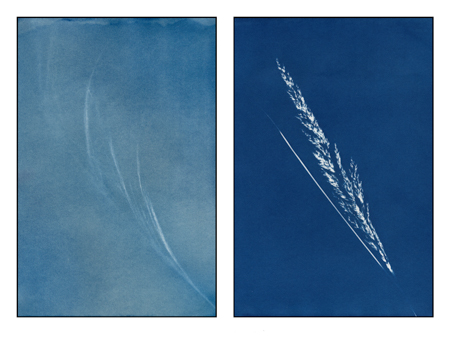
My first attempts
You ask about the outcome? Well, not what I was expecting, that's for sure. Instead of a rich, blue, commanding cyanotype, I produced that pale, indistinct, life-less print (on the left) even after leaving it in the sun for 15 minutes. Another attempt, the darker, more distinctive one (on the right) better fitted my expectations – but that was sitting in the sun for 3 hours, not for a 'few minutes'.
Misquoting Lady Elizabeth:
Oh Cyanotype. Thy name is disappointment!
It's my good fortune that 165 years have passed since she wrote that article on the disappointments of photography (the one I mentioned earlier, HERE … ). And our knowledge and understanding of the techniques have progressed beyond her conjecture that "something in the air is absent, or present, or indolent, or restless." I also have the advantage of online tutorials, blogs and Kindle books at my fingertips. But they weren't really needed – not straight away – because reading the instructions properly (rather than simply skimming the headlines!) identified that 'indolent' factor as UV‑light, rather than simply daylight. And, whilst the two may be broadly synonymous in California where the 'how-to' guide was written (at the University of California) they certainly aren't in Yorkshire!
Further advantages of the 21st century enabled me to purchase a small (A4-size) UV lamp and pre‑sensitised paper. And in this way I was able to take control of the process, make it consistent and repeatable, thereby producing the 'rich, blue, commanding cyanotypes' of my mind's eye.
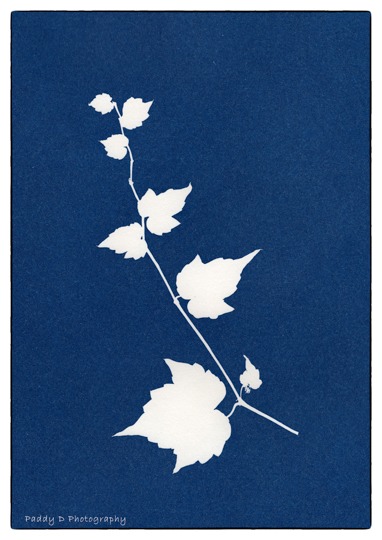
Not disappointing at all.
The Victorian Age
In her introduction to ‘Photographs of British Algae: Cyanotype Impressions’ (1843) its author, the botanist Anna Atkins, wrote:
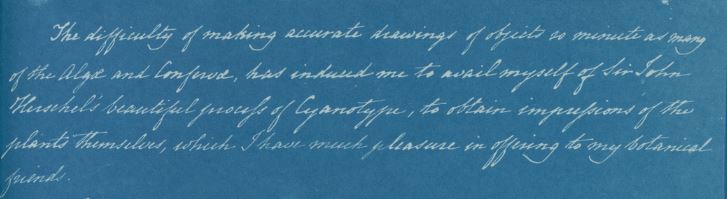
“The difficulty of making accurate drawings of objects so minute as many of the Algae and Confervae has induced me to avail myself of Sir John Herschel's beautiful process of cyanotype to obtain impressions of the plants themselves, which I have much pleasure in offering to my botanical friends."
Over the next decade she created at least 17 copies of her 3-volume work. But there was no print‑run by the publishers, no mass production – and the word 'photographs' in the book's title may have misled you into thinking she photographed the original and then created 17 copies, quickly and easily in a darkroom. But no!! There were none of these labour-saving advantages available for her.
Instead, every page was produced entirely by the cyanotype process – every botanical illustration (with every plate name for each specimen, in Latin) and all the text. Moreover, she made every print herself – and several copies run to over 400 plates each. I can’t begin to estimate the amount of time, effort and dedication she devoted to the task of creating this (arguably) selfless work – intended as a companion to the ‘Manual of British Algae’, an unillustrated publication by William Harvey (1841).
She must have pre-prepared each individual sheet of paper (covering it with light-sensitive chemical), because the first commercial cyanotype paper didn't become available until 1872 ("where it was produced by Marion et Cie in Paris under the name papier ferro-prussiate", according to The Getty Conservation Institute); then collected and prepared the specimens; hand-written the captions and text; and then repeated the process again and again for thousands and thousands of prints.
And now, comparing my own recent experiences of learning the cyanotype process with those of Anna Atkins, I'm aware that my respect for her and the people of her time has risen many-fold. This only turns the clock back some 200 years, but I feel I can better understand why Ian advocates the teaching of the Middle Ages in schools, saying that:
If students can respect people of a time as different from our own as the Middle Ages, then perhaps there is more chance of them respecting people from different cultures today rather than instinctively interpreting difference as being inferior or a threat.
Ian Dawson, said frequently