Finding Focus on the Course
It’s a few months since I embarked on ‘Finding my Focus’ with Rachel, and I’m now sitting by the window (with the spring rain pounding on the glass) reflecting on what I learnt, what I discovered and what new directions I’m now following.
Over the course of five sessions, Rachel introduced the genres of landscape, still life, abstract, portraiture and themes of home (the latter a crossover between abstract, still life and documentary photography). And whilst the genres might be predictable, the range of photographers and the diversity of their work certainly wasn’t. Her selections were eclectic, stimulating and thought-provoking – inspiring me to create new, exciting, surprising images, undreamt of in the past.
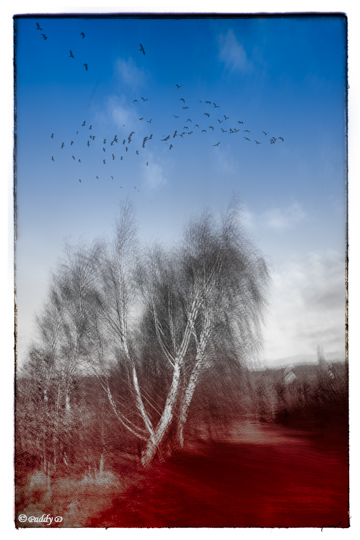
Can I hear the land screaming?
Prompting me towards greater ecological and environmental awareness
Rachel and her ideas have also highlighted many of my preconceptions, challenged them and shown them to be outdated.
Over the last decade I’ve taken several courses on the History of Art (with the universities of Oxford, Edinburgh and Leeds) and also studied the History of Photography. And this has undoubtedly helped inform my photography, particularly improving my ‘eye’ (my compositional skills and sense of light and tones). But I’m now aware there’s been an unhelpful legacy. I’ve developed an undue deference for artists of the past – the great and the good. And with typical impostor syndrome (aware that all my formal education is in science and engineering, not art) I can suffocate under the weight of what I hold to be ‘proper’ – I imagine these proper photographers always create proper images at proper venues.
But Rachel made it impossible for me to hold on to this misleading myth. I couldn’t look across the range of the photographers she presented, and their work, and apply any one single, universal stamp which could define ‘proper’. One of Ansel Adams’ Yosemite landscapes is like chalk to the cheese of an abstract by Uta Barth – their only similarity is the photographic medium they both use. And I found this exciting and liberating – finding my focus meant focusing on my own work; being inspired and informed by the past but not intimidated by it.
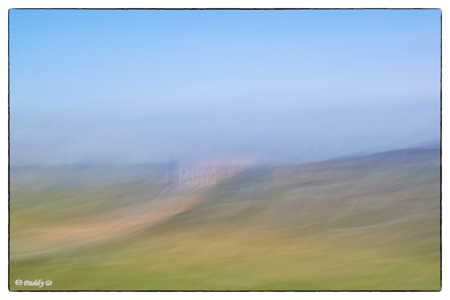
A Better View
Soft, ethereal, otherworldly
The two genres which surprised and excited me the most were still life and abstracts. The first because I had previously envisaged it only in the terms applied to paintings from the past (comprising arrangements of dead fish, dead birds, dying flowers and other memento mori); the second because, unexpectedly, I’ve become mesmerised by the soft, ethereal, otherworldly qualities it can incorporate (eschewing a preference for clear lines, distinct shapes and precise geometry which I would have predicted). And hence I've chosen a few of my recent abstracts to illustrate this project.
With still life, finding my focus means focusing on my ideas, my messages, my stories – not agonising over whether the subject matter is natural and spontaneous, or a deliberately constructed tableau.
With abstract images, finding my focus means focusing on what I’m feeling and experiencing instead of what the camera thinks I’m seeing. And in turn it’s enabled me to step away from the tyranny of certitude and precision which digital photography and sophisticated post-processing techniques encourage (and the illusion they represent an exact, perfect world). Instead, I’m encouraged to adopt more in-camera techniques – ICM, shallow depth of field, bokeh, LE, multiple exposure, movement blur – to explore a world which is simultaneously amazing, wonderful and deeply flawed.
Overall, Rachel has shown me that ‘finding my focus’ means chasing butterflies and rainbows – following my ideas, my passions and my feelings with confidence, self-belief and a light heart.
Thank you xx
You can now read more about my experience of Rachel's course,
and the different images I created by following:
Or you can continue with my overview of Rachel's course with the link below: