
The Course:
About the Walks
‘Reframe Your Now: Mindfulness Photography for Mental Health and Resilience’
I’ve been doing courses for over a decade now, attending workshops and being mentored, with the sole aim of improving my photography. So, it’s understandable that I initially thought about this as another photography course – after all, it does have the word ‘photography’ in the title – and I continued to think about it in that same light in the ensuing weeks while I took, then shared, the resulting photographs.
Now I understand the course differently; I understand that Ruth has created an amazing wellbeing course which, incidentally, has expanded my ideas about photography, rather than a photography course which has incidentally improved my wellbeing. But it’s taken me several months to reach this conclusion – in fact, it's taken so many weeks that it's made me realise I’m not well-placed to discuss Ruth’s ethos and methodology (and I doubt I could do her justice).
So, instead, I’ll concentrate on telling you about the impact the course has had on me.
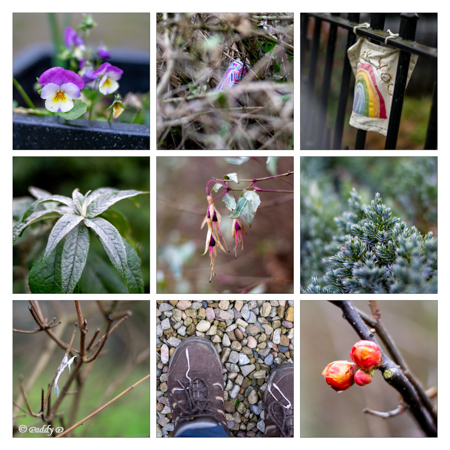
Still Curious
The first benefit, which occurred almost immediately, was that Ruth “changed the way I look at the world around me; how I see it and engage with it” as I wrote in the Prelude. This occurred through her simple, but highly effective, suggestion to ‘slow down’ – to take mindful walks in which childlike curiosity, attention and observation replace the tendency to ‘get on’, rushing from A to B.
I began to walk around the local streets following her advice to be inquisitive, looking for colours and textures, contrasts and opposites, man-made items and natural ones. And here I found an absorbing, engaging, interesting mini-world I’d never noticed in all the years we’ve lived here.
This suggestion has added a freshness to the way we see our well-known locality. I’ve become more aware of the small pleasures around me (in the plants, shrubs, trees, birdsong) as well as the rich heritage of this suburb of Leeds (its architecture, stonework, residual woods and parks, the influence of nineteenth century development). And every walk contributes more to this tapestry of wellbeing – the anticipation before I leave home; the engagement and wonderment of the walk; and afterwards, looking back and remembering the experience.
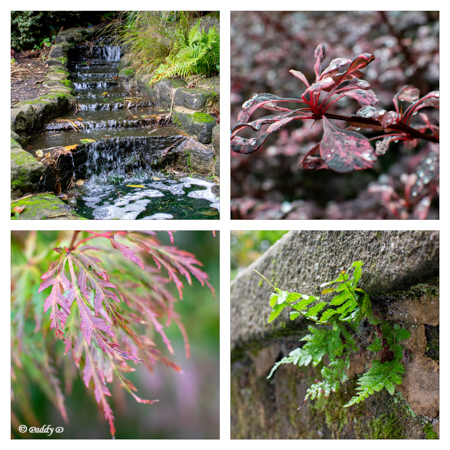
The Japanese Garden
There’s a second benefit in these walks, that of a peaceful mind.
Too often in the past, I’ve taken these same walks but done so on autopilot while my mind continues to struggle with the anxieties and concerns of the moment. The problems which had overwhelmed my mind indoors remained the problems which overwhelmed my mind outdoors. And I suspect, my body continued to be tense and anxious, my breathing shallow. But, when I’m on a Ruth-inspired-walk, my mind is fully engaged with the world around me; instead of anxiety and distress it’s busy being amazed, intrigued, fascinated – it’s a time of mental respite. I return home soothed and calm, more positive, less distressed, less self-critical. And I have a window of opportunity – growing longer with each passing week – to use this peace of mind for well-balanced thought, allowing me to make realistic judgements and assessments, and better, calmer decisions.
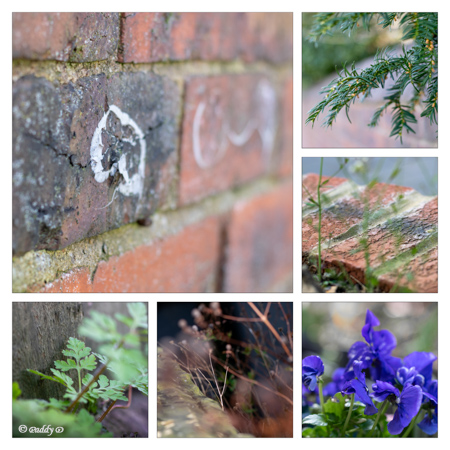
Beauty on My Doorstep (VI)
At first, I thought the camera was an essential part of this process, but I've now taken plenty of walks without one and I know that my level of interest, engagement and observation has remained just as high; I can be curious and observant without a photographic-prompt and it’s just as beneficial to my wellbeing. But I had to learn to do camera-walks before I could learn to do camera-less-walks.
The photographer Dorothea Lange asserted that “the camera is an instrument that teaches people how to see without a camera” but, in my experience:
Ruth is the person who teaches people how to see without a camera.