
Portrait (II)
The Image
Also inspired by the work of Christoffer Relander, this is my first attempt at creating a multi-media image, combining maps and conventional photographs.
The Story
Whilst modern maps, particularly those online, help you get from A to B quickly and efficiently, I prefer old maps because they talk to me. They allude to the history of the area, tell me about the land, about the place. I can see how the old names live on – how Weet Wood is remembered now as the suburb of Weetwood, Stain Beck as Stainbeck; how Bracken Hills Wood remains only as Brackenwood Drive.
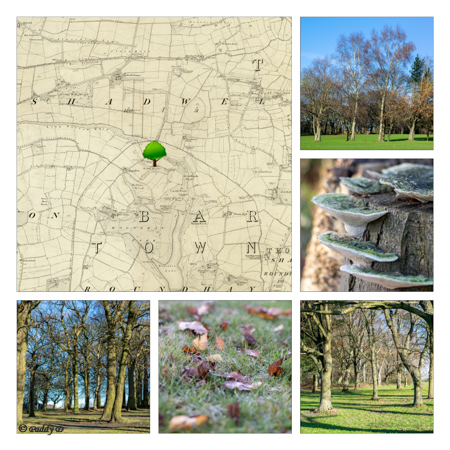
A Short Story of North Heads Wood
So, this is a short story of North Heads Wood – its portrait – starting with its history as told by the six-inch, ordnance survey map for ‘Yorkshire, including Leeds, No.203’ (surveyed in 1847 and published in 1851). It tells me that my woodland was part of rural Yorkshire – surrounded by fields and flanked by Great Heads Beck, Great Heads Wood, Castle Wood, Hollins Wood, Home Farm and two sandstone quarries.
In contrast, the Google Map of today tells a different story – it tells me about the streets of the suburbs, the Ring Road, the Park, the relentless march of urbanisation in 170 years – and tells me that North Heads Wood is sadly reduced in stature. And the website of Leeds City Council tells me it’s lost its individual identity – it’s simply described as one of the “eleven separate wooded areas” which constitute Roundhay Park Woods, which itself is subsumed into the Forest of Leeds.
But if I walk there, take a moment to stand and look around me, I see a small pocket of that original woodland still survives, standing proudly, seemingly unaffected by the 21st century.
In Retrospect
This is another genre in which Rachel showed me how traditional and out of date(!!) my ideas were. None of the examples she showed came close to replicating staid paintings of dull historic worthies, in dull historic settings!
Again, it was the work of Christoffer Relander which inspired my ideas – the way he combines dissimilar images. I started to imagine the creative ways I might take objects which reflect my own interests (particularly in maps) and combine them with references to my subject. Then I expanded my ideas to other multimedia possibilities which blend images with the written word – books and newspapers – and the image below is my first attempt at the latter.
Don’t try to work out its message – it doesn't make any sense, even in a parallel universe! There’s no conceivable logic of combining a photo of Ian wearing a Roman Army helmet, with a page from an 19th century edition of the Manchester Guardian – it was simply the pragmatic use of two available images, which has enabled me to gauge the visual outcome. But the result has intrigued and excited me – maps, the written word, multiple images, icons and symbols – how might I use them to help me express unspoken feelings?
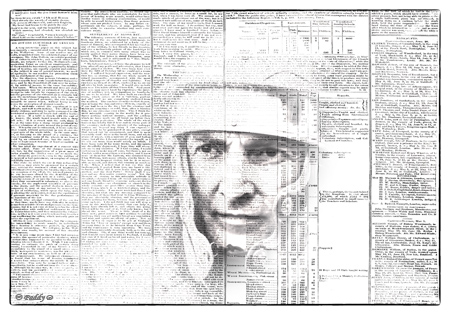
Trying out a multi-media approach