
Themes of Home
The Images
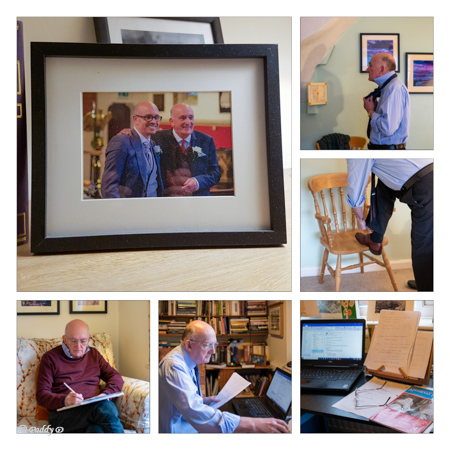
This home-play collage tackled themes of home – the domestic environment.
Presence and Wellbeing
The Story
Much of our past medical trauma is related to Ian's experiences in the early 80s and so this portrait, (created 40 years on, with Ian aged 70 next birthday and in the midst of a pandemic) celebrates his 'presence and wellbeing’.
The collage starts with the biggest cause for celebration in recent years, our Matthew’s wedding with Sarah – strong evidence of Ian’s ‘presence’, contrasting with all the times of medical uncertainty. It records him – a very proud parent – sharing a moment with our son as they await Sarah’s arrival into church, on the arm of another proud parent. And yes, as you’d imagine, there were two proud mums just out of range of the camera, too.
The surrounding images are testimony to Ian’s ongoing wellbeing (and I could have also shown him playing tennis as another example). His retirement was temporarily interrupted for 6 months across the winter as he returned to returned to teaching. And this gave me the opportunity to photograph him as he prepared to run an online session for trainee history teachers.
You probably expected to see the ones on the bottom row – a final run-through of his notes, before sitting at his laptop and getting his desk organised. But it’s the two on the right which always make me smile, the ritual of getting dressed – like getting his cricket kit ready in days past. Habitually, he starts with the shirt and tie and ends with the leather shoes – a routine which remains the same whether he’s teaching online or ‘in life’.
This truly is a celebration of ‘presence’.
In retrospect
Even though Rachel introduced the genre as an interesting crossover (between abstract, still life and documentary), presented an exciting range of ideas, and I subsequently enjoyed creating a positive, celebratory image, I struggled with 'Home' (and have continued to struggle as I'm writing about it). Partly, the subtitle – Domestic Bliss – made me uncertain whether it was intended seriously, flippantly, jocularly or ironically. But mostly, it was because I was also overly conscious of one of the examples Rachel introduced – the work of Richard Billingham and an image about his alcoholic father.
Initially, I was tempted to explore a similarly intense and emotive theme of my own through photography – the medical reality of my life (and that of Ian), and the everyday, ongoing medical legacy. I knew that, if I sought cathartic benefit from exploring such a raw topic, then Rachel and the group provided the ideal, safe environment in which I could do it – supportive, non-judgemental, encouraging. But later I decided that this would not reduce the impact of medical trauma (and might, in fact, aggravate it) and I dismissed the idea. However, I couldn’t fully shake off this train of thought – it was as if I had tunnel vision – and so I tried to side-step the medical issues, aiming to be more celebratory with my home-play, focussing on ‘presence and wellbeing’.
With the passage of time, and applying a different mindset, I could perhaps engage productively with one of the other photographers who Rachel introduced – she gave us enough intriguing possibilities – but I fear that might still feel difficult, more like home-work than home-play! And there’s no need for me to take this route. My notes from last November are packed with Rachel’s exciting ideas about the other genre – which stimulated and exhilarated me at the time and have spawned a myriad of other ideas – so it would be a waste to expend creativity on the genre which interested me the least.
I’d much rather chase butterflies – run with all the exciting ideas which Rachel and the group shared.