
It's a Question of Names
Before I continue, I’d like to add a note about nomenclature – and the fact that I call this my ‘Gledhow Project’ when nearby Roundhay believes it has a greater claim and is already making petition in my mind’s ear in favour of the ‘Roundhay Project’. It’s arguing that it’s more well‑known, larger, more affluent; that Gledhow hangs precariously on Roundhay’s ‘edgelands’; and it cites the Parliamentary Constituency of Leeds NE in support – that, in official circles, Gledhow is subsumed into the ward of Roundhay. But to me, this is the behaviour of the haughty relative one meets reluctantly at weddings, christenings, and funerals, and on those grounds, I’m declining the appeal and affirming it’s the ‘Gledhow Project’ – it’s more intimate, more personal, more homely.
After all, a quick glance at a local map shows the dominance of the name ‘Gledhow’ in the area immediately around us – in street names (Gledhow Lane, Gledhow Avenue, Gledhow Wood Grove, Gledhow Grange View), in old buildings (Gledhow Hall, Gledhow Grange, Gledhow Hill House), in Gledhow Valley, Gledhow Valley Woods, Gledhow Primary School, Gledhow Park and in the Gledhow Sports and Social Club. Even early Ordnance Survey maps (the 1847 survey, for example) print ‘Gledhow’ across this area with ‘Roundhay’ printed further east – a practice that ‘Google Maps’ continues to this day.
So Gledhow it is!
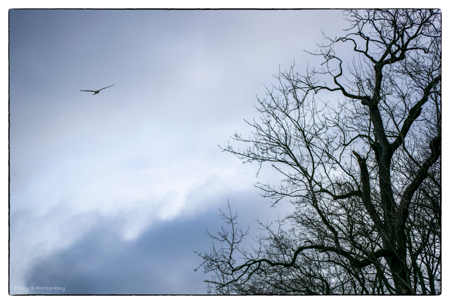
Gledhow – the ‘hill of the kite’
There’s another reason that I've opted to call this my ‘Gledhow Project’ and that comes from the derivation of the name itself – well, one possible derivation of ‘Gledhow’ – that it comes from Old English for the ‘hill of the kite’. And that seems pleasantly pertinent because red kites have been regularly over‑flying the entire area since a conservation programme introduced them to the Harewood Estate (some 6 or 7 miles away).
So repeating myself, Gledhow it definitely is!