
What gives Gledhow its character?
I'll show you several features that answer this question about the character of Gledhow but for me the most important is the presence of trees – there are trees everywhere. We can see them as soon as we step out of the house, then in a garden at the end of our ‘street’ and then on street-corners, lining avenues, in small strips of woodland and in Gledhow Valley Woods (it's one small part of the ‘Forest of Leeds’).
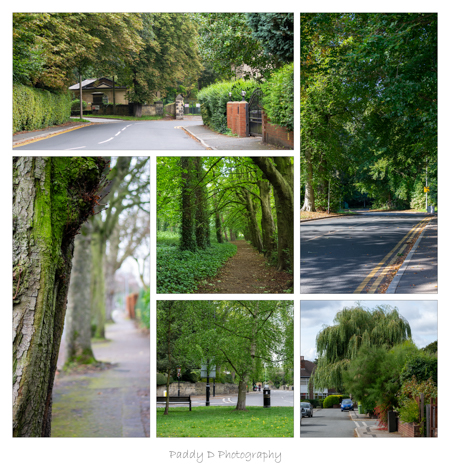
The Gledhow Paradox – a city suburb with trees and shrubs everywhere
Next there’s the number of shrubs and plants, and the amount of greenery.
Most of the houses in Gledhow have gardens (both front and back) and although some have been covered with concrete or hard-core for parking, there are flowers for all seasons and greenery everywhere you look – grass, hedges, shrubs and lichens.
Then there are historic buildings as well as stone walls, stone paving and setts (blocks of stone used in the construction of roadways) that all add to the local character – a lot of which are associated with Gledhow Hall. And even though the hall itself is tucked out of sight, the old estate walls, gate piers, the stables and cottages, and the estate's own bridge (formerly linking the hall with its farm) are all visible, completely dominating the top of Lidgett Hill.
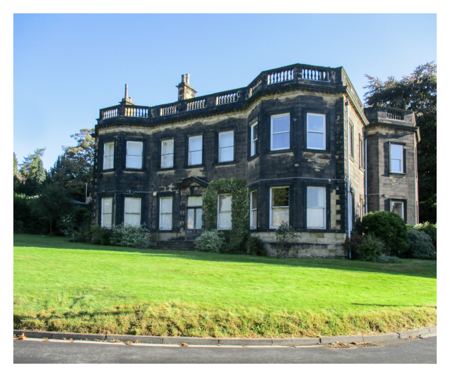
Gledhow Hall
Painted by JMW Turner in 1816 – but now hemmed in by housing
And I must remember to mention the wide-open spaces throughout Gledhow – the schools’ playing fields, the children’s play park by Gledhow Field and ‘The Gledhow Sports and Social Club’ (my first introduction to the area was playing hockey there in about 1972 or 73).
A Gallery of Gledhow
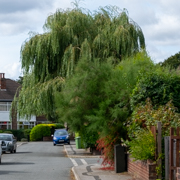
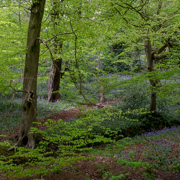
So maybe it's time to show you a ‘Gallery of Gledhow’ – hoping it will give you a better flavour of the area than any number of my words …
|
|
|
|
|
|
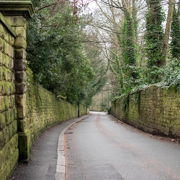
And now back to the character of Gledhow …
Next I need to tell you about the wildlife because you might imagine this city landscape as a desert in terms of animals and birds – devoid of all living creatures – but, again, Gledhow is blessed with bird life. We see the little blue tits, coal tits, sparrows, wrens and robins in our garden daily, and more rarely a bullfinch. There are also the larger magpies, blackbirds, thrushes, collared doves and red kites – we can usually tell when the kites are nearby, because the volume of the bird-calls increases, warningly.
There are both common pipistrelle and Daubentons bats in the nearby Gledhow Valley Woods and I think we often see them – certainly small bird‑like creatures fly around the roof-tops at dusk – but they don’t stand still long enough for me to confirm this! And our next-door neighbours have added ‘host plants’ to their garden to help conserve butterflies and so we benefit from that, too.
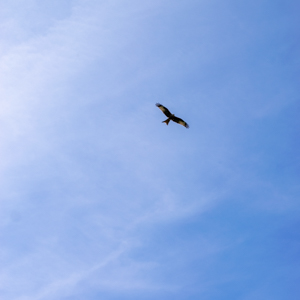
A 'kettle' of red kites roosts on the nearby Harewood Estate
There’s also the fox who makes his cautious way through the gardens, quiet and wary, again mostly at dusk – his behaviour so unlike the multitude of grey squirrels that dash around. They scuttle across the grass, tunnel through hedges, raid the birdfeeders, hurry through the trees from branch to branch or sit statue-like on fences and roofs. They’re regular and welcome visitors even though, officially, they’re classified as ‘invasive pests’ and the Woodland Trust states:
“Scampering grey squirrels are a familiar sight, but sadly these American imports have had a disastrous impact on the native red squirrel.”
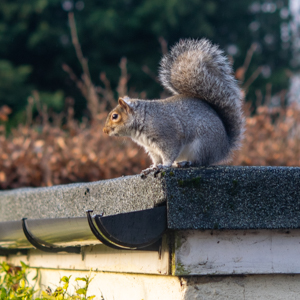
A statue-like squirrel
Lastly, I believe that the number of community groups adds to the local character. For example, Gledhow and the surrounding area is very well ‘friended’ (there are the Friends of Gledhow Valley Woods, the Friends of Gledhow Field, the Friends of Roundhay Park and the ‘Love Oakwood’ group) and is well protected too (by the Gledhow Valley Conservation Area and the Roundhay Conservation Area). Then there are the ‘activity groups’ – the Roundhay Artists, the Roundhay Open Gardens Group, the Roundhay Ukulele Group, the Allerton Grange Fields Community Orchard as well as numerous groups associated with the local churches – St. Andrew’s, St. Edmund’s, Lidgett Park Methodist, Oakwood Church and Oakwood St. John’s – and several more groups I’m certain that I’ve missed!
So, overall, I hope this brief, illustrated ‘flavour’ of Gledhow has helped you understand that in terms of this sector of Leeds at least, G.B. Shaw was entirely wrong to suggest that complete obliteration was a necessary solution. There’s more than enough character here – from trees, greenery and wildlife to stonework, historic buildings, wide open spaces and community groups – to create a real sense of individuality and make it somewhere I’m happy to call home.