And now Roundhay:
the haughty relative!
So, now that I’ve mentioned Roundhay, I’d better complete the introductions. Otherwise, it’ll just keep nattering in my mind’s ear!
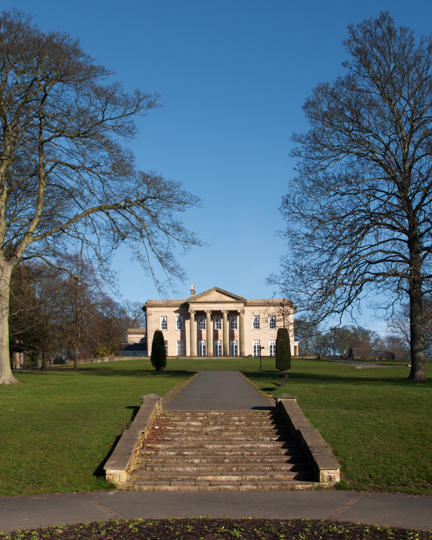
“The really wealthy … built themselves huge mansions … at Roundhay”
The local ‘My Learning’ website (a resource site for schools, managed via Leeds Museums and Galleries) explains:
“By the time Queen Victoria came to the throne in 1837, many better off families in Leeds had moved out of the smoky, polluted city centre. They bought newly built houses in leafy areas to the north of Leeds, like Headingley, Chapel Allerton and Potternewton. The really wealthy moved even further out into the countryside, and built themselves huge mansions at Weetwood, Roundhay or Adel.”
At some point, I’m sure that I’ll discuss the physical and socio-economic legacy of this ‘really wealthy’ elite, and the relationship between Roundhay and its ‘edgelands’ – Gledhow and Oakwood. But, for now, I’ll give you a short textual introduction to Roundhay together with another illustrated ‘flavour’.
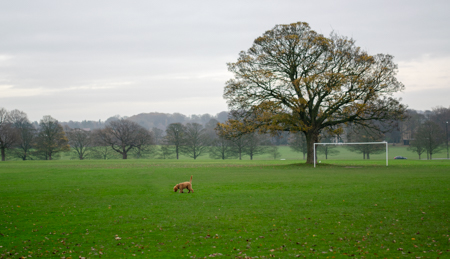
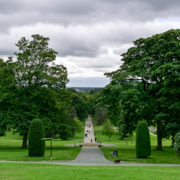
‘A large splash of green’ – the wide open space of Soldiers' Field
If you look at the map of Leeds on Google Earth and track northeast from the city centre, the urban grey of buildings and roads suddenly gives way to a large splash of green – marked as Roundhay Park and Soldiers’ Field, Roundhay Golf Course, Leeds Golf Club, woodland and farmland – an open area which forms a square of about 1.5 miles on all sides (2.3km) and yet lies completely within the physical boundary of the Ring Road. And it’s the park (including Soldiers' Field), occupying about half of the area, which is the ‘hallmark’ for residents and visitors, with its abundance of features ranging from the ‘big house’ to the lakes and the sports’ fields.
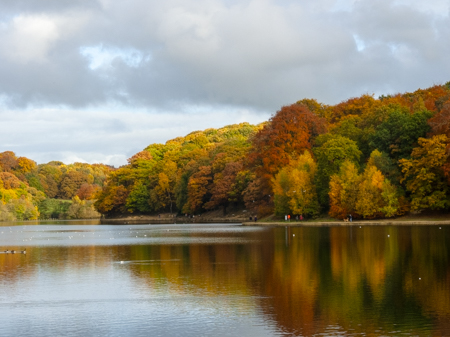
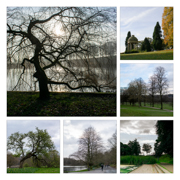
Autumn on Waterloo Lake, Roundhay Park
I started listing the different elements within Roundhay Park, and this is where I got to:
Firstly, there’s the ‘big house’, The Mansion (that includes The Garden Room Café, the English Art Co. gallery and the Ann Maguire Education Centre), its stable block (now The Roundhay Fox public house), its gatehouse and carriageways, and its walled garden (incorporating Tropical World, the Butterfly House and another café!) with Canal Gardens, the Friends’ Garden, the Rose Garden and the Japanese corner alongside.
Next there are the two lakes – the larger one is Waterloo Lake (at 800m long it’s big enough to be the home of the Leeds Rowing Club) whilst the smaller one is the Upper Lake (with herons and kingfishers it’s a regular haunt of birders). Then there is the Roundhay Gorge (a geological feature) and small pockets of woodland (Ram Wood – formerly known as Hollins Wood – Castle Wood, Great Heads Wood, North Heads Wood, Fox Wood and Braim Wood).
Next there’s the Castle Folly; the Glen; Barran’s Fountain; the Bowl; the Monet Garden, the Alhambra, and the Specialist Gardens; the old paddling pool (formerly the Lido, now a carpark!); Hill 60 (offering kite flying and sledging to youngsters and a rite of passage to teenagers who sit up all night and watch the sun rise); Soldiers’ Field (once the site of Roundhay Airport(!) but now the wide open space is used for cricket matches, football, rugby league and provides the opportunity to just run around.
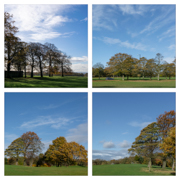
I think you’ll see from this list (and the gallery below) that there’s something for everyone – young and old, immobile or active – and it’s this that makes Roundhay Park so special, so memorable and, in truth, diificult to ignore.
A Gallery of Roundhay Park
Again I think it's time for a gallery, rather than an ocean of words …
|
|
|
|
|
|