
About Questions (and Answers)
Recently, I've noticed that I struggle to answer the most basic of questions:
What kind of photography do I enjoy?
What style of photography do I prefer?
What kind of photographer am I?
And to these I’d add my own question, am I really a photographer at all?
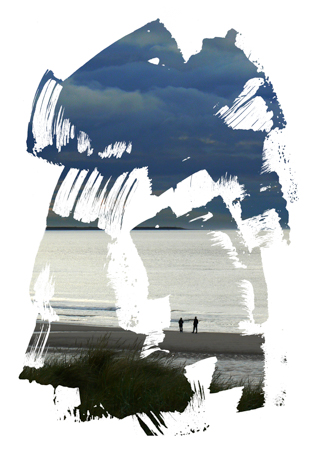
‘A Window on the Past’
from my ‘Art Therapy Project’
Perhaps it was easier in the 70s when I first took up photography. Maybe nobody asked me then! After all, photography came fourth behind my family, my career (in engineering), and my sport (in both hockey and cricket). But if you ask me now about that photographic-past, I'll admit that it was the darkroom-process which excited and engaged me – developing the films and making the prints. I simply used the camera as a tool to provide raw material for that activity – used it to take photographs of the people I saw and places we went, recording our everyday lives.
Turning the clock forward to the 2000s, I'd taken early retirement, started to take photography more seriously and that was when those tricky questions first arose – mostly when meeting up with other, more experienced, better photographers (‘better’ in my eyes, anyway). And that was when the struggle began – my desire to sound like a ‘proper’ photographer, rather than an engineer, (particularly one who confirmed the stereotypical image of engineers – low in artistic flare, imagination and creativity).
Then fast forward again to 2023 and it's clear that the intervening years have still not equipped me to answer these simple questions in a confident and succinct way. Helen, a newly-met photography-friend in Sweden asked me something very ‘normal’ i.e. the type of question one naturally asks on meeting a fellow-photographer:
Where do you normally find inspiration for your photography?
What kind of photos do you like taking?
And the email I wrote in reply was comparable in length to the 6-volume set of Barsetshire novels by Anthony Trollope! Ooops!!
‘Untitled’
from my ‘Art Therapy Project’
It's over a week since I wrote those opening paragraphs and, in the interim, my mind has continued to analyse these ideas, to process and re-examine them. I've also been re-reading the entries in my website-journal and engaging with my earlier projects – adding more fuel to the mental fire – and I feel that I've identified several important trends.
Writing Reviews
Firstly, there’s the frequency with which I apparently stop what I'm doing and write a review of the ‘story’ to date – just as I'm doing now.
In fact, it's only a matter of time before I review all the reviews!
Now I realise that it's not a total ‘stoppage’ per se. It's as if I have inbuilt antennae which recognise that I’m losing my way, and which encourage my engineering persona to step up and offer a second opinion. Thus, the mathematician/scientist side of me that likes things to make sense, that seeks patterns and structure is able to give my creative persona another viewpoint, another interpretation. And, in turn, this gives me the opportunity to step back from the issue in hand, to rethink, regroup and, when I start again, to feel refreshed, energised and re-motivated.
My job description
Secondly there's the question of what I should call myself now? How should I define myself? Can I find a simple word or phrase that acts like a current-day job description? Because it's clear that, at different times, it was/is important to me that my new-found creativity deserves the epithet ‘artistic’. The honorific of ‘Eur. Ing’ has been rescinded – that was my qualification of decades as a European engineer – but has not been replaced by anything as informative, as clear, as succinct, or in truth, by anything at all.
Does this absence explain my quest to find a traditional, conventional nametag for myself?
Does this all affect my sense of self?
I think it does!
My creative/photographic process
Lastly there's the consistency of my creative/photographic process across decades. For me, the interest has always lain in the darkroom – in the physical darkroom processes of the 1970s, and in the digital darkroom techniques of today. And it’s this which drives the causal sequence of my photography, making it a loosely linked, 3-stage process – never a fully integrated, pre-visualised activity (of the type I credit someone doing ‘proper’ photography!) – a journey of discovery:
With a few exceptions (mostly when I’m doing an assignment or I'm working on an idea for a project), my ‘photography’ is reactive – not predicted, nor pre-imagined – and hence follows this sequence:
1. The chain of events has always started with the things that Ian and I do (or, more strictly, ‘did’ enjoy doing before the fractures) – visiting churches and cathedrals for example, and taking woodland walks (all of which offered a kind of green therapy – calming, soothing, enriching and energising).
2. The camera then comes next in the sequence, allowing me to make a record of these outings and to create a visual sketch – a prompt, a reminder – of the experience. I'm more camera-savvy than I was in the 70s – I have a better skill-set in terms of composition and lighting; I know more in-camera techniques and can apply them confidently (long exposure, ICM, double exposure, shallow depth of field, panning etc.) But largely, the camera is still just recording the places we've been, and the things we're doing. Twas ever thus!!
3. Then finally, the sequence culminates in the darkroom (now the digital darkroom) – in my mind the most valuable, challenging and interesting part of the entire process; an opportunity to be experimental, playful, curious (and that’s the operative word – curiosity). Sometimes I want to make the factual representation of the photograph into an image with greater interest and focus, with heart, soul and feeling; I want to make my images reflect the way I felt, not simply show you what I saw. But then, there are other times when I’m like a child on a sugar-rush and I just want to see what happens if (metaphorically) I ‘prod a bear with a stick’!!
So you’ll now understand why my photography always follows this sequence. It’s because I can’t predict what I’ll see while we’re in situ, what will catch my eye and ‘demand’ to be captured on camera, or how I’ll be feeling at the time, or how I’ll feel some hours (days) later when I’m sitting at the computer and embark on post-processing. And, for me, this is what makes my photography exciting and stimulating – it’s all about my love of the ‘process’ (and its therapeutic impact), rather than the ‘outcome’.
But does it give me permission to call myself a photographer – a ‘proper’ photographer?
I doubt it!
And does it really matter? Should it really matter?
I doubt that, too!!
But, as I've already noted, it is having a slightly negative effect on my sense of self.
As another thought …
Having worked through this issue in some depth I realise that my definition of ‘proper’ photography and ‘proper’ photographers is very narrow. I've a cognitive bias which is self-excluding, making my definition lean heavily towards the landscape photography of Charlie Waite, and well away from the work of artists who inspire me, such as visual artist, Valda Bailey.
And knowing this, it feels less important whether I’m called a photographer, or an artist, or …
But I’d just like to be called something – something polite, that is!!
And as an aside …
This description of my photographic process helps confirm why I’m struggling to enjoy my camera-based photography since the fractures – simply that Ian and I are going to fewer places. And many of these sporadic visits are overshadowed by the ‘practicalities of firsts’ – the first visit with the wheelchair and its attendant learning-curve – so there’s never a chance for my photography to get started.
In addition, I’m aware there’s a second factor which comes into play. My photography has always been about the spontaneity of the moment – the walk through the woods, or my movement around the church – and so my physicality and mobility were inherent, integral parts of the process. But, as yet, I can’t replicate this from the chair, or compensate for its absence and hence it’s another reason why the camera has lost its magic.
And now, as a conclusion …
Near the beginning of this discourse I wrote that a review of this type “gives me the opportunity to step back from the issue in hand, to rethink, regroup and, when I start again, to feel refreshed, energised and re-motivated”. And it’s working – it’s allowing me to formulate an answer to that photographic conundrum.
So that now, if you ask me about my photography, I’ll explain that it’s largely eclectic and spontaneous; wide-ranging in every facet – in inspiration, subject-matter, and style. For me, it’s the fun, the challenge and the stimulation of the photographic process that’s so valuable, and it’s just a lucky upshot that the outcome (the resulting image) is often pleasing and wall-worthy (i.e. something I want to frame on the wall, or share with friends).
Ok, this is not as pithy as saying I’m a ‘landscape photographer’, or a ‘photographic artist’, but it’ll do for now – until a better answer comes along.
Stay safe xxxx