
Making a Breakthrough – Or Not!
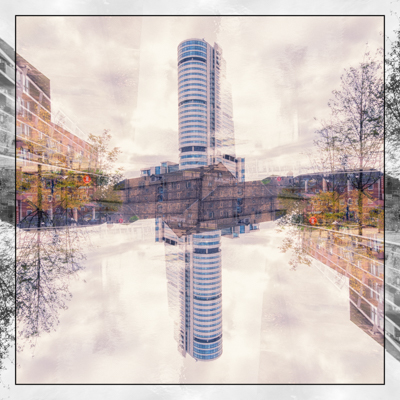
A mirror tile of Bridgewater Place and the Granary Buildings
The original photograph was taken by Lock No. 1 of the Leeds & Liverpool Canal
It’s nearly Easter (i.e. it’s late March) and I’m looking back over the year to date, and I can see that I've been chasing that old dream again – the one about being a ‘proper’ photographer.
I’d seen an online talk by the Swedish photographer Erik Malm last autumn and there was something in his methodology that re-ignited that old dream in me. Maybe I could modify his technique enough to make my photography ‘proper’ again. Maybe it would help me to embrace wheelchair photography, instead of struggling to make the transition and, as a consequence, blaming it for being a poor imitation of my former, ‘able photography’. And maybe I’d regain the confidence to aim at producing 'wall-worthy' images – good enough to hang in an exhibition or (hopefully) a commercial gallery.
So I enrolled on two tuition sessions that Erik held online, watched another of his online talks, then waited impatiently for my mind to process the details and to formulate a new modus operandi that would make camera-work enjoyable and rewarding again.
In the meantime, almost as a distraction, I started to look for inspiration and became intrigued by the images of Glenys Garnett (a local, Wakefield-based photographer) and of Cherry Larcombe (from East Sussex). And so I began to practise one of their creative techniques – one that uses Photoshop to create ‘mirror tiles’, like the images you can see above and below.
(You can see a brief outline of the way I make them HERE).
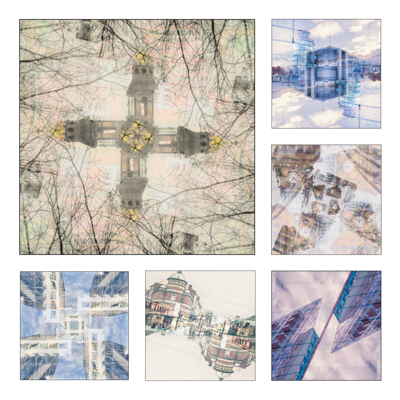
More examples of mirror tiles based on buildings around the city
The technique appealed to my playful and curious persona, and I was soon raiding my back catalogue for photographs that I’d taken in and around the city, aiming to identify the characteristics that were necessary for a successful ‘tile’ with an architectural theme. There was something addictive about the process and the stack of tiles grew larger and larger (as shown in the example above) – enough to redecorate the bathroom!
Next, I turned to my collection of cyanotype prints – using the clear, simple outlines to create tiles with more geometric patterns (below) – and then I extended the idea by ‘acquiring’ black and white silhouettes from the internet (mainly of trees in winter) and converting them into patterns.
These geometric designs really were addictive, but I believe they have an almost philosophical element about them too – an emotional-strength – which I noticed by chance, when I made a mistake by simply omitting one of the mirror stages when I was making one …
Suddenly I saw something beautiful but imperfect – the tile bottom right – interpreting it as a visual metaphor that contradicts modern life perhaps, with our cultures that demand flawlessness, and respect nothing less.
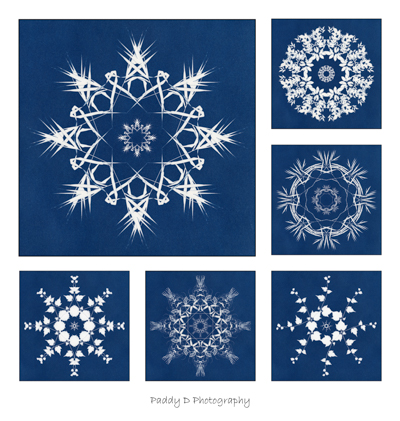
‘Perfect, Imperfect’ – a metaphor for modern life?
Geometric designs based on my cyanotype prints
Looking at these geometric-tiles, I was half-minded that there’s an area of mathematics that studies patterns and inevitably headed to Google for confirmation. Both my professional and academic lives had revolved around the mathematical equations that predict pressure surges in pipelines and unexpectedly – really unexpectedly – I had found myself discussing Joukowski’s Equation recently in a queue at the local hospital, while a stranger and I waited to see the phlebotomist!! So perhaps this explains why I happily dived into mathematical theory and disappeared down a rabbit hole of fractals and Fibonaccis, tessellations and tilings and (briefly) considered doing the Open University’s OpenLearn Maths unit on ‘Patterns and Formulas’.
Before long I was looking at ‘Penrose tiling’ (below) and was reading an article on the Mathematical Association of America website, ‘Mathematics as the Science of Patterns’ by Michael N. Fried that noted mathematics “connotes order, regularity, and lawfulness” and asserts that the whole subject is about patterns:
“Patterns are often the explicit subject of mathematics—sometimes even in the perfectly ordinary sense of the word, as in the study of ‘tilings’ and ‘wall-paper’ symmetries.”
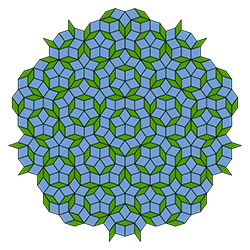
I’m reliably(?) informed (i.e. by Wikipedia) that this is
‘A Penrose tiling with rhombi exhibiting fivefold symmetry’
© Wikipedia
Next – yes, it’s been quite a journey, hasn’t it – a photography friend introduced me to ‘Art Forms in Nature’ by the German biologist, Ernst Haekel and there was something about the softness, the gentleness of the images (below) – that perfect-imperfection of nature – which made me take an abrupt, handbrake turn away from the cold, clinical, starkness of my geometric designs.
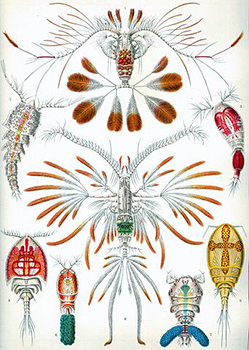
‘Copepod’ by Ernst Haeckel
Plate 56 from ‘Kunstformen der Natur’ (1904)
© Wikipedia
At first, I simply added colours and textures to temper the distinctive outline of the cyanotype print (below), but I soon realised that if I wanted a more natural image, I could turn to nature itself!!
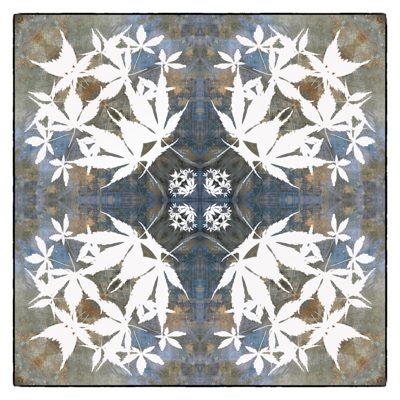
The geometric design of a cyanotype print,
softened by a textured background
So feeling like Homer Simpson (but resisting the temptation to slap my forehead and shout ‘doh’!) my inner voice ventured that nature would surely be able to deliver a softer, more natural image. And so another phase of tile-making followed as I explored the potential of grasses, flowers and bushes to create more subtle, restful images (below).
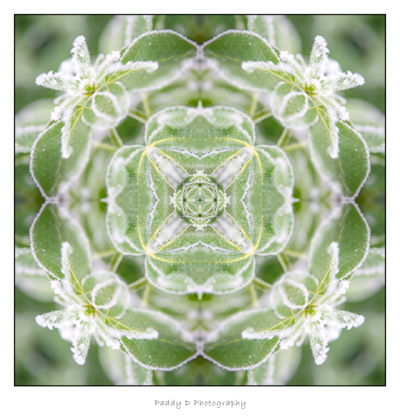
A mirror tile from nature (I) – frost on the leaf of a shrub
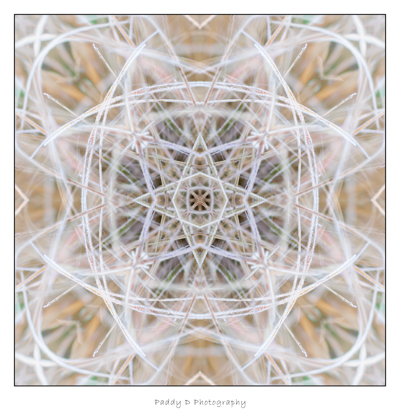
A mirror tile from nature (II) – ornamental grasses in winter
So now a few more days have passed, it’s Easter Sunday and I’m still waiting …
“impatiently for my mind to process the details [of my Erik-Malm idea] and to formulate a new modus operandi that would make camera-work enjoyable and rewarding again”.
This excursion into mirror-tiles has been fascinating and absorbing; there have been times of complete captivation and I've been in a state of ‘flow’ – using Mihaly Csikszentmihalyi’s definition (aka ‘in the zone’); I've enjoyed seeing the way that my ideas have evolved. But, and it's another of those big ‘buts’ …
Where’s my new modus operandi? Where has it got to?
What’s stopping me – my mind – from making my great photographic breakthrough?