
Part 2:
Sandpit Time
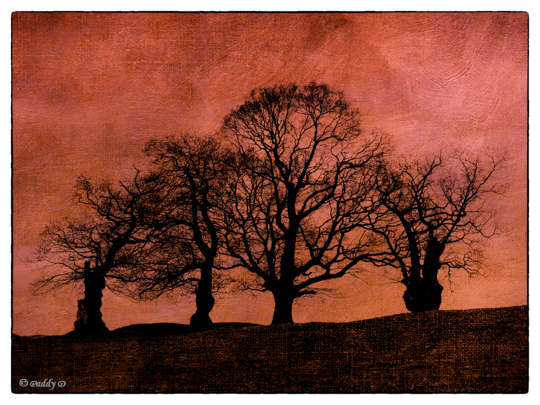
On The Margins
from 'Woodland Miscellany' Series
I know that the process of reflecting on my learning is the sign of a mature student; but I also know it appeals to my science/engineering background and my need for things to be logical, to make sense. But my analytic skills fail me when I try to describe my recent photographic experiences. I can’t find a simple, orderly, logical, linear narrative as I could for the earlier phase of my training. And that’s why I know it’s been a journey of more than one part, firstly from 2008-18 and secondly from the summer of 2018 to the summer of 2019. If the subtitle for the first phase was the implicit question ‘does it look right?’ then the subtitle for the second is explicitly ‘does it feel right?’
Looking back yet again, I can see the point where my self-imposed adherence to ‘Emulation’ started breaking down and ‘Divergence’ began, i.e. “making something that’s uniquely [mine]”, as Todd Henry describes it. The signs were visible from early 2018 although, of course, I didn’t recognise it as such.
It began with me failing to envisage the ‘right’ photo for my landscape assignment (and being distressed by my inability); and struggling to produce the ‘right’ image in Dam Square, at a workshop in Amsterdam; and being disappointed that the ‘right’, classical image of a walk in Ram Wood felt inadequate, inexpressive – felt so wrong.
But so much in the programme of mentoring with Julia was working well – working very well – that it was easy to push these doubts to one side.
Then the phase of mentoring came to an end (almost certainly to resume in the future) and I stood at my learning-crossroads again, asking myself, where next? And, if I’d followed the well-worn pattern of my journey thus far, I know I would have looked for an online course or a workshop to fix this ‘not-right’ problem. But perhaps the idea of ‘not-right’ was too vague; perhaps the intensity and the successes of working with Julia had left me, temporarily, behaving like every school kid, at the end of year – summer holidays, yippee.
Atypically and unexpectedly, I became experimental and playful, trying ideas I’d seen on Twitter and Facebook, posted by photographers of all type, shape and creed – I took an unstructured, unorganised, whimsical approach to the summer; a very un-me approach to ‘non-right’ photos; the trial and error behaviour of a 5 year old.
At first, it was just about playful experimentation and happy, accidental outcomes; and realising that these happy accidents had the potential to solve some of my photographic problems. For example, I started by trying a technique of double exposure, variously adopted by others on social media to represent ‘near and far’, 'solid and ethereal', the passage of time, memory etc. And, for me, it became a ‘tool’ which meant I could describe the chaos of Dam Square, for example [ HERE … ]
Some of my photographs began to feel right.
Other techniques and styles followed – abstraction, colour, background-blur, blended textures, silhouette and more. Some ideas worked, many didn’t. I soon found some were more forgiving, transferable. Others were more specific, more challenging, more satisfying when I got it right and understood their intrinsic characteristics. Now I could describe:
• the multisensory experience of the woodlands [ HERE … ]
• the contradiction that a 1000 years of castle and cathedral history is now a tourism opportunity (alongside).
More photographs felt more right, more often.
Is this the way that children learn? Freely? With an open mind? With curiosity about the world about them? Certainly, this period felt gloriously childlike to me – ‘playing in the sand pit’ is how I describe it – engaging more and learning more about my surroundings and the world I inhabit (local woodlands, the nearby city, churches and cathedrals). And, with that child-like excitement, wanting to tell everyone I know about what I’d been doing and show them the products.
But slowly I began to recognise that something deeper was happening. Happy accidents became autobiographical; I could imagine using some of these new images to illustrate aspects of my life:
•
‘On the Margins’, for example (the image at the top of this page) – the way it felt to be a scholarship girl and, years later, to be a woman in engineering
• ‘About Loss’ (alongside) from 'Hearing the Voices' series.
These aren’t simply a ‘snapshot’ which represent the way I felt in that moment as I walked in the woods, they’re revealing more – they’re exposing more of myself to me, maybe to you as well.
I remember Julia saying, “if you don’t want to know about yourself, don’t become a Fine Art Photographer”.
Is this what she means?