
A Safe Space
A recurring comment amongst the members of the group was that the course created a ‘safe space’ – a phrase I've never heard before in the context of any other course I've taken whether in photography, art history or drawing. So why did we have this unusual reaction? What led to our collective sense of security? Was it something to do with the way that the course was delivered i.e. online, directly into our own homes? (I’ll confess – that was my first assumption). Or was it the idea which I’m now coming round to – was it primarily because of Ruth herself, her ideas, and the way she shared them?
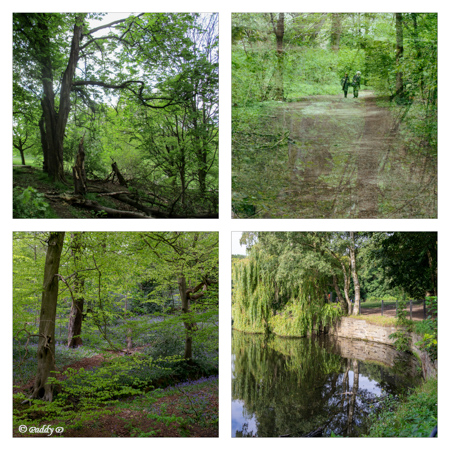
It's not a coincidence that the women (top right) looks like Mum
I started exploring these ideas about a 'safe space' by thinking back to the different courses, workshops and 1-to-1 mentoring I've experienced since 2008 – and it turned out that the pros and cons of their means of delivery is worthy of a blog in itself.
The earliest online course I did was with the OU. I worked in the comfort and familiarity of my own home, and at my own pace but I only ‘met’ the rest of the group in a rather awkward, remote manner, through the written forum. In contrast, the 'real' group workshops I've attended have all been enjoyable for the stimulation and camaraderie of meeting the other participants in the flesh (so to speak). But time and focus were always expended in establishing these (temporary) relationships and, oddly, there were never many opportunities to share our photographs or drawings. Now the sudden explosion of IT opportunities (which Covid has accelerated) means I can add a new type of course to the mix – 'live' online, group ones. And it feels like these offer the best of both worlds – the familiarity and convenience of participating from home, added to the friendliness and encouragement of seeing and meeting my ‘accomplices’.

Contemplation
Applying these thoughts to Ruth’s course, I think that one reason for the sense of security and ‘safe space’ was that we were all within our own homes, within our own comfort zones (the uncertainties of IT communications permitting) and so we felt able to take emotional risks; to turn our energy and focus to the new ideas on offer; to be open and receptive to them; to be excited and stimulated – willing to share something of ourselves and our experiences.
Looking back, I can see I was less reserved, less cautious than I might have expected – I didn't need to keep 'things' at arm's length. I can best liken it to those unexpectedly intimate conversations that can develop with a stranger on a train – but, in this case, our own homes and computer screens replaced the confined world of the railway carriage.
So, my first idea was that the sense of collective security was wholly attributable to the technology which had enabled us to meet online as a group – the argument felt compelling. But several weeks after I had reached that conclusion, I embarked on a 10-week, online course on the History of Art with the University of Edinburgh. And this led me to re-examine my thoughts.
The Edinburgh course was delivered in exactly the same way as Ruth’s course (i.e. I was sitting in the same room, with the same computer, at almost the same time of day) and so I was well within my physical comfort zone again, but the atmosphere wasn’t replicated. The course was very enjoyable – stimulating, exciting, energising, informative – but I’d never talk about it in terms of a ‘safe space’ or liken it to an unexpected meeting with a stranger on a train!
So now I believe that my first assumption was wrong – the most significant aspect in our ‘safe space’ was never the technology – that was only ever secondary.
The most important factor was Ruth herself.
Her quiet manner, her style, her assurance and reassurance; the tone of her voice; the manner in which she shared the ideas and techniques she had developed the ‘hard way’ through her own experience; and her generosity and willingness to do so. She created the environment which enabled me to take emotional risks and focus on the new ideas on offer.
It was Ruth who made the space a safe one; the participants respected that (and supported it); and last of all, the technology facilitated it.
That’s who the safe space came from.