
About Seeing
Ruth's course has prompted me to think about 'seeing' again – think about what, in particular, I see and pay attention to when we’re out walking, for example; or the reasons why I might overlook something which Ian notices and is absorbed by. It’s a subject which has a relevance to all the visual media but, in photography, tends to be pushed into the background by more immediate photographic issues – composition, exposure, lens selection etc.
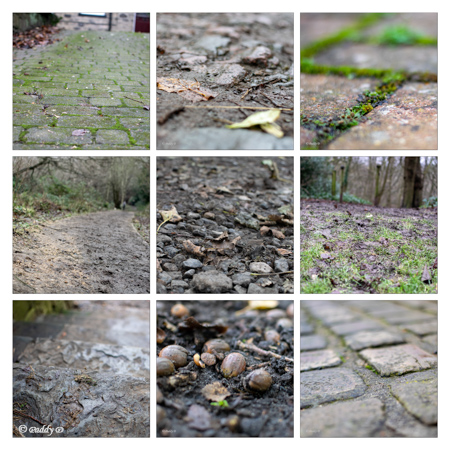
As my Nan always said, "Mind where you put your feet"
For a long time, I subscribed to Dorothea Lange's thesis about seeing – that “the camera is an instrument that teaches people how to see without a camera” – because I do find I'm more observant when I'm carrying a camera. But then I noticed that there was still a lot of repetition in the photos I was taking – Dorothea’s way of seeing ‘more’ didn’t ensure a never-ending, limitless supply of fresh, unique images.
So, then I started reading about the subject and found that visual training can play a part (according to Betty Edwards); and visual acuity (Patrick Trevor-Roper); and interest, expectation and attention (Alexandra Horowitz); and doubtless there are a myriad of other factors. But now I'd like to add a very simple reason to the list, that we see more whenever we're prompted to do so – whether it's by the physicality of carrying the camera; or by the freshness of visiting somewhere new; or, as Ruth has shown me, when someone suggests it!
During the course, she talked about taking time to be curious – looking out for colours and textures, shapes and patterns, high and low, above and below. And each time I've been out walking, I've found this simple suggestion to be unexpectedly effective in adding a freshness to the way I see our well-known environment. Moreover, I’m now adding more and more possibilities to the look-for list.
It’s as if I can hear Ruth’s voice in my mind’s ear, “hey, have you noticed the flowers on that fuchsia, or that winter pansy; or that moss on the wall; that arcade of trees; that blue plaque about Gledhow Hall; the tooling marks on that wall; the crack in that paving stone; those grasses; that golden carpet of beech leaves; the survey mark; that …”
Then, her voice follows up with “have you looked up at the sky above you; felt the ground beneath your feet; heard the birdsong around you; smelt the …”
At first, I thought the camera was an essential part of this seeing-process, but I've now taken plenty of walks without one and my level of interest, engagement and observation has remained just as high – Ruth’s ideas ring in my ears just as strongly. So, to paraphrase Dorothea Lange, I believe that:
“Ruth is the person who teaches people how to see without a camera.”