
What has photography ever done for me?
My photography in the 70s and 80s
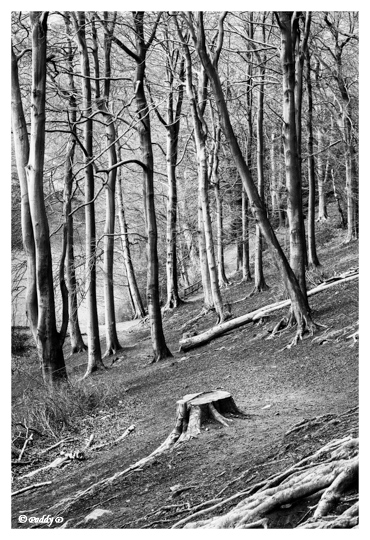
Gledhow Valley Woods, Leeds
I’ll start with a confession. This isn’t one of my prints from the 70s or 80s; it’s a more recent, digital image. If you saw it in a gallery it would be labelled ‘in the style of … ’ or ‘inspired by … ’
When I started to write this section, I imagined it would be easy to illustrate it with photos from the time, but I can’t find any prints in the attic. I did, however, find two files full of negatives and ok (I thought), it must be simple enough to digitise some of them and then manipulate them from negatives into printable ‘positives’ in Photoshop. But it isn’t as simple as I imagined. It proved frustrating and disheartening. After several hours work, I had just two images to show for the effort; and these were indistinct and blurred – more reminiscent of the earliest days of photography in the 19th century – and definitely not the quality of print I remember producing at the time.
(Alternatively, my photography was never as good as I remember – but let’s not go there).
If I’d taken time to seek advice on the internet, I’d know that digitising images is a task of hours (preferably with specialised kit) not a thing of minutes and I’m impatient to get to the core of this project. So, I’m restoring my equanimity by going with Plan B i.e. showing you recent digital images which are similar to photos I took in the past.
Now returning to the question in hand …
What has photography ever done for me?
My photography in the 70s and 80s
It It all started innocuously, back in the late 1970s, when my then-boss introduced me to the mysteries of the camera, to black-and-white film and a traditional photographic darkroom. My polite, nodding interest quickly escalated and before long, I’d entered a rich, new, secret world. I felt like a curious child, finding a ball for the very first time, intrigued by its shape, its texture, its behaviour.
It’s hard to imagine now, when I've eight or more cameras in the house (and almost everyone carries a phone-camera), that it was very different in the 70s. Back then, my camera was something which just sat in the cupboard for most of the year and made a rare excursion for holidays and the occasional outing – and I’m sure that was true of most people, not just me. I carried it around with me, clicked it a few times (when I remembered I had it with me), finished the film when the holiday ended, sent it off to Boots for processing and the prints would return, some time later – to then sit in a cupboard undisturbed for decades. And in this respect its use was no different on our honeymoon in 1976 than in my childhood. But that changed completely when then-boss introduced me to the magical world of photography and to the mysteries of darkroom – to processes and techniques which were fundamentally unchanged from the first days of photography in the 19th century.
He showed me that a camera could be part of my daily life and being, and that it was an activity which offered challenge and engagement. Before then my camera was a simple point and click device – the ultimate WYSIWYG – I pointed it, clicked it and prints appeared at some later date. There was little about me (as a photographer) in the process, other than choosing the direction to look in, and the moment to click. But this new activity made me curious, presenting me with choices and involvement; with a wide-angle lens I could open up the view; with a close-up lens I could wonder at overlooked details. And there were choices aplenty in the alchemist's paradise – the darkroom – in developing the film, sizing and composing the image, choosing the paper and making the print.
I took to it with gusto, bought second-hand equipment – a camera, some lenses and kitted out the darkroom – and enjoyed learning how to use it all. I’d been introduced to photography in a very technical way (particularly to the darkroom) and I’m sure it appealed to my technical mind – formulaic, organised and procedural. I could apply an analytical eye to the world around me and, like an observer, record it in a detached and clinical way. I also had the pleasure and challenge of learning something new – but something well within my comfort zone (and hence I had an innate confidence that I’d be able to master it!) It appealed to my inner-geek and, I’ll admit, one of its attractions was the opportunity to impress then-boss.
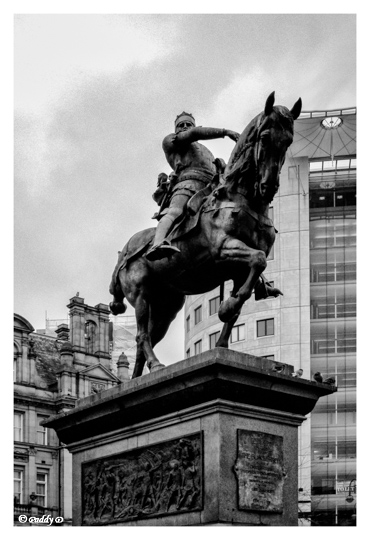
The Black Prince in City Square, Leeds
Another image 'in the style of the 70s'
So, that explains what happened, how it came to pass and why I enjoyed it but I’m struggling to get back to the question, ‘what did this phase of photography ever do for me?’ When I look at the later (digital) photography, I have continuity from 2004 – when I bought a digital camera in Perth (Scotland) to capture the sunsets over Schiehallion – continuity from that moment up to the present day. I can see patterns, turning points, significant moments and people. And, importantly, I can connect back to the 50-something ‘me’ who started to make those tentative photographic steps. But I’m finding it difficult, nigh on impossible, to re-connect with that fresh-faced 20-something who was involved with black and white photography and the darkroom, back in the 70s.
That, in turn, leads to another thought – one big difference between my early black and white photography and my later digital work wasn’t technique or experience, it was me. The early phase was less significant and had less impact on my sense of self and my wellbeing simply because I didn’t need it to; my confidence and self-esteem were well satisfied by engineering, sport and life in general. Photography in those days was just an interesting, slightly unusual activity that I was good at (maybe part of its attraction was that, like engineering, it was atypical for a girl!) And, whilst busy with the day job, I didn’t have the time it would have needed if I’d wanted (or needed) it to be important – the time to learn, to practice, experiment, play, consider, to mature and then repeat it all again.
It’s different, though, if I look back to that period and talk about its legacy, rather than its impact at the time – there it changes from being a slightly irrelevant diversion to being momentous. Most importantly, I’d enjoyed it, been good at it (in my memory, at least) and I’d done it at a positive, assured, self-confident time in my life. And this positive association proved invaluable in later, less confident times (post cancer, post engineering) because it allowed me to make an almost vicarious reconnection with my youthful self, picking up photography again with confidence and with positive expectation.
Thinking back to the period and browsing through my negatives, other aspects of the legacy are visible in the seeds that were sown – even if, at the time, I was largely oblivious of this deeper potential. It showed me what a camera could do, what photography could be; it encouraged me to carry a camera in my daily life, and to photograph the people I know and the places I visit habitually – the local parks and woods, the city, the hills, the rivers; it introduced me to almost 150 years of photographic history – giving me an insight into the achievements of the pioneers and the challenges they faced, enabling me to respect them; it reintroduced me to the rewards of childlike curiosity. And, without these seeds – the foundations that were laid – I wouldn’t be sitting here today, thinking about photography and what it’s ever done for me.
NEXT: Photography in the 80s and 90s
P.S. Walking back from the park today I saw the Dog’s Trust sticker in the back of a car (a dog is for life, not just for Christmas) and I can envisage every camera-enthusiast saying something similar since the dawn of photography – a camera is about your life, not just about your holidays.