
What has photography ever done for me?
Fine Art Photography
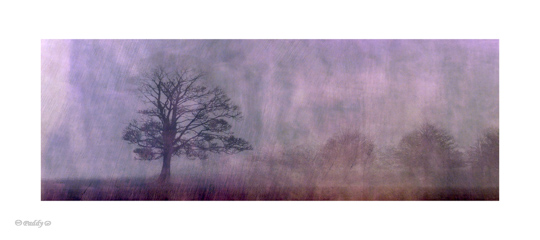
The Blasted Moor
I started writing about fine art photography ahead of schedule (i.e. before the section on the development of my digital photography) in the belief that I would tick it off quickly and get onto the real substance of this lockdown project – i.e. digital photography itself. Well, that was nearly 3 weeks ago and since then I’ve been writing like a demon; I’ve written 13 different items on my fine art, plus spending time to consider the question “do I want to be a ‘proper’ artist instead, a painter artist?
The early phases of research into my photography in the 70s/80s and 80s/90s should have given me some clues that this would happen – I thought they were also quick-tick sections but I found it unexpectedly interesting, absorbing and useful to pause and spend some time on them. And fine art photography has proven that it’s no different.
I’ll be quite honest, there’s a part of me (an exceptionally large part) which is suspicious of my fine art photography. I can hear my father’s voice in my mind’s ear telling me that I’m just being child-like, childish; plus, I think the engineering mind always struggles to value things it cannot measure; and also because one of the reasons for adopting this looser, more relaxed style of photo-editing was not related to artistry at all – simply that it’s less demanding physically on both my manual dexterity and my eyesight!
It feels as if I've spent three weeks arguing with myself on paper; as if my engineering persona has been challenging another unnamed, unspecified part of me to justify itself. And it has! – justified itself, I mean. A creative persona has emerged – a persona which I didn’t really know existed – strong enough to hold its own when my engineering persona starts to bully it.
Well, it can emerge, if I let it.
It feels as if this creative persona has been amassing a wealth of supportive evidence, but in a disconnected way – I've written about a range of items from flow and colour to individuality for example. But through it, I've gained a clear understanding of my fine art photography – what I’m doing, how I’d do it and how I benefit.
Last year I was describing my fine art photography as an ‘interpretation.’ Later I concluded its value is in helping me make my images feel ‘right’ – my woodland photos had originally seemed too ordinary and mundane, for example, whilst my fine art versions allow me to express more pizazz, more of the pleasure and wellbeing I’d experienced while we were out walking.
Now I’m clear that my fine art photography allows me to make an invisible story into a visible one; to express feelings and emotions which otherwise remain internalised and unresolved; a story which is associated with the scene in front of me (and hence the scene captured by the camera) but is not explicitly visible there. I could tell you the story in words – and I’m sure I would if the time and place were right. But often they’re not and so fine art photography lets me tell you using visual language instead. And in this way my images will share joy, excitement, long ago memories and more difficult issues, such as loss and medical trauma.
In this way, fine art photography helps me deal with the messy, irrational, illogical, emotional, unpredictable world we encounter every day.
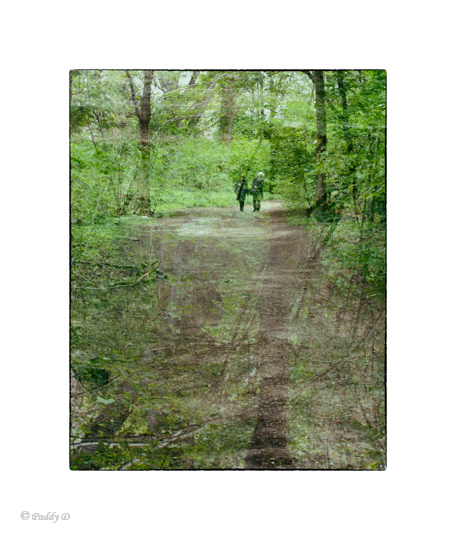
There's No Title …
but the woman on the right looks like Mum
Several things have surprised me while I’ve been looking into my fine art photography. One of them is the way in which time seems to have raced by over the last three weeks. And realising that this is a common occurrence with my fine art photography – losing myself in it, becoming immersed, absorbed, focused, less stressed, less anxious. I’m ‘in the zone’ as they say in sporting circles (in ‘a state of flow’ in psychology terms). I feel challenged by the task in hand but confident I can rise to it and, consequently, I reap the benefits – well-being, contentment, pleasure and motivation. Best of all it’s fun; I feel like I’m flying, and all that old engineering scepticism falls away.
That’s what fine art photography has done for me and now that the project has made it explicit, I’m benefiting even more.
Another surprise relates to expressive freedom. After a lifetime constrained by the laws and practices of science and engineering I was certain that the freedom to express what I want, in the way I want, would be at the top of my list of benefits. But that’s not the case – certainly it’s on the list, but not at the top. I've discovered that the freedom to be unpredictable and be surprising is more valuable – particularly the freedom to surprise even myself.
I’ve also been astonished by the words I’ve been using throughout my writing. Is this really me who’s writing here? There’s palpable excitement in my tone – the engineer's caution is pushed aside, dis‑ease and anxiety are forgotten and instead I’m describing fun, enjoyment, wonderment, amazement. And I’m less concerned by the title of ‘artist’ i.e. whether or not I am one. Instead I’m more excited to welcome the emergence of my creative being – a side of me which, presumably, got left behind about 50 years ago.
Not every thought has been neatly resolved though; I've discovered that the individuality of my fine art photography is important to me, for example, but oddly, I’m not sure why it matters. (Many other people must have taken the same photographs as me at Bamburgh, Fountains Abbey and Lake Windermere but I'm certain no one has created the same fine art). And there's an elusive issue called 'something else' which is only partially explained. So there’s still more to learn, more to discover.
But if I’m ever asked what I’ve gained from the last three weeks it’s that I’m alive to the idea I’ve an expressive, creative persona not just in engineering one. I can hear its creative voice more clearly and it’s telling me to be more confident, to have more self-belief. And not to let it go.
That’s what fine art photography does for me.
P.S. You can find out more about my fine art photography – the very long read! – HERE …
