
What has photography ever done for me?
My photography in the 80s and 90s
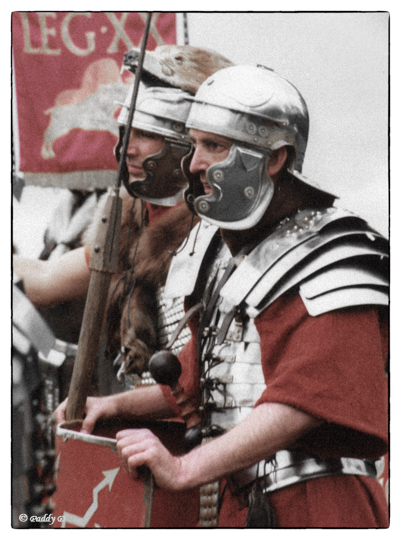
Ian on exercise with The Ermine Street Guard
Boroughbridge, 1991
My black and white photography stopped abruptly in 1983, even more abruptly than it started; the toxic chemicals were dispatched to the garage the minute we learnt I was pregnant and later, the baby’s need for a bedroom was greater than my need for a darkroom. My memories of the period are naturally dominated by the challenges and pleasures of parenthood and, as a consequence, I tend to forget that my photography continued, albeit in a different way. Black and white film was replaced by colour film, at-home printing replaced by commercial printing. It was almost like the 1950s all over again – except, and it was a big exception, I became more aware of the camera. Whereas the 70s were characterised by me learning darkroom skills, the 80s and 90s became a time for me to learn about camera craft.
When I was doing my own printing, I was always able to make improvements to the basic photo that I'd taken with the camera. I’ve a natural tendency to tilt the camera to the left, for example, and a lot of the early negatives tilt that way. But this was easy to correct in the printing stage – horizons could be levelled; buildings made less Pisa-like. I always knew I could put it right – make an average looking negative into a stronger looking print. And I could improve the balance and the composition as well, by printing only the best parts of the negative – omitting distractions, too much sky, too much foreground. But, of course, I lost the safety net once I dismantled the darkroom, so then I had to make sure I got things right first time – in the camera.
And that’s what happened. Slowly over the months, I started taking more good photos more often. And, in turn, that fueled my interest in learning about the technical capabilities of the camera more fully – arguably an overdue interest but my attention in the 70s had been focussed on the darkroom, far more than the camera itself. I gained more experience with the different lenses and learnt more about the camera settings, exposure, shutter time and aperture. My photographic ‘eye’ became more attuned to assessing the scene in front of me, leading to stronger images – better composition, balance and movement, better storytelling.
As you might imagine, our Matthew was an ideal subject in this period – the main subject for several years to come; Matthew the baby, the toddler, the youngster; ideal pictures for grandparents (we have a poster-size collage on our wall that I made for Mum in about 1990); ideal for us as parents too. He proved an ideal subject, unknowingly helping me to make progress along my learning curve.
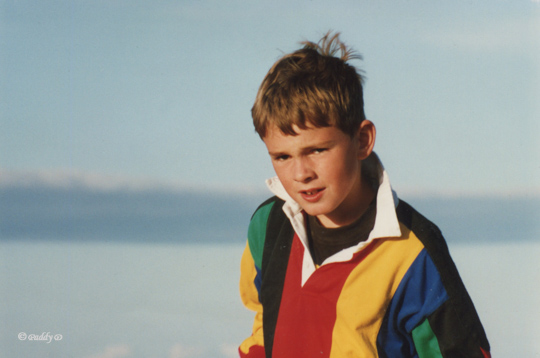
Our Matthew
France, 1991
There’s no specific reason that I gave up my photography in the 90s, nor a specific date I can point to. I just carried the camera less often and one day, stopped altogether. Perhaps Matthew was becoming more self-conscious; perhaps I wanted to participate more fully in family life instead of being an observer; perhaps it was time to step out from behind the camera; perhaps I didn’t need it any more.
This phase of my photography was never as momentous as the earlier phase in terms of what it means to me; and it couldn’t have felt explicitly important at the time – if it had, I wouldn’t have stopped. But it did have the advantage of consolidating every seed that had been sown in the 70s.
As well as filling a box in the attic with treasured memories.