
Looking back, looking forward:
Where next?
I spent a lot of time yesterday looking back (i.e. re-reading everything I’ve written over the last few months) and then looking forward (i.e. thinking about where next?) And part of the looking back process found me reviewing the project itself, not just its main conclusion that my photography is fundamentally about my wellbeing.
I took time to appreciate just how much I’ve enjoyed doing this project – an absolute pleasure. I’ve been ‘flowing’ through it – in the zone, as they say in sport – absorbed, focused, content, happy, at ease. Flying! It’s delivered far more than just a convenient way of passing the time in lockdown. And emphasised the benefits of working on a project with a specific aim and projected outcome, rather than working reactively on individual images as I capture them.
I also noticed that I haven’t been as objective as I expected. I thought that I’d provide more photographic evidence or specific memories; that I’d struggle to let the project develop organically; that my engineering habits would make it very ordered, orderly, balanced. Instead, it feels more subjective, interpretive, emotional and freeform, free-flowing. That was unexpected – and, somehow, that has increased the pleasure of it all, knowing that I fully relaxed into it.
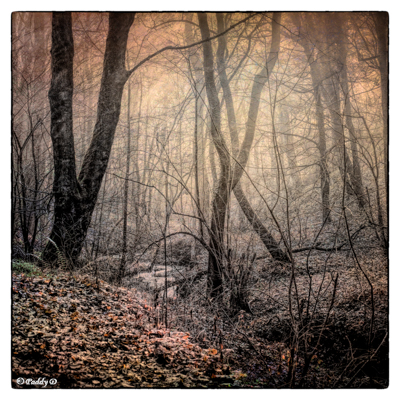
Overlooked Places, Outside and In
In the midst of a pandemic, it’s understandable that I chose to highlight the wellbeing benefits of my photography. But this project has also charted the emergence of my creative persona (which had lain neglected and underdeveloped for over half a century). And I’m excited and curious to see where and how this persona will develop; and what environment will prove to be the most nurturing and fruitful.
I saw a program on television recently which included a retired scientist/turned-artist who had done an MA in the History of Art, followed by one in photography. And, a few months ago, this might have prompted me to reconsider emulating him – I’d certainly had that very thought a few years ago. But now I've become aware of my fledgling creative persona, I feel it needs protecting. I’m certain it would flounder and be at risk from academia – from someone else’s timetable and structure, filling my mind with more knowledge and technique. My creativity is just a youngster – it needs the opportunity to be childlike and playful, to continue learning through curiosity and experimentation.
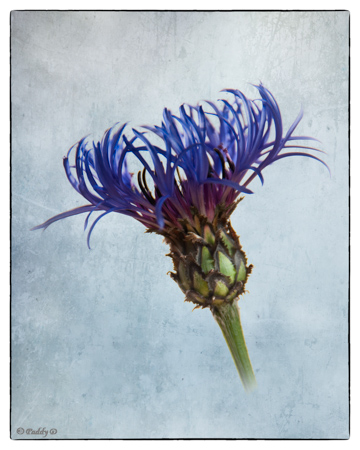
Untitled
As the final part of my looking-back review, I’ve been thinking about my favourite photographic subjects – trees/woodlands, churches and botanical studies; they dominate my collection of images from the past and will, I’m sure, be the bedrock of my future photography. And my engineering mind starts to test them, to measure them amongst themselves. So I choose criteria – two set by Dawn Hansch, founder of the Society of Obsessed Women Photographers (i.e. do I feel emotionally connected to the subject and do the finished images warm my heart each time I see them?) together with two of my own criteria (firstly of ownership – no borrowing, acquiring, copying or emulating other people’s style or emotions – and secondly of making a positive contribution to my wellbeing). And trees and woodlands score particularly well. Three years of curiosity, playfulness and experimentation are delivering an exciting body of woodland-work which I hope to enter for the next Great North Art Show in Ripon. But, unexpectedly, I find that botanical studies and churches satisfy only three out of the four criteria – they fail the heart-warming test.
No! That can’t be right.
I’ve had to stop writing, I’m so surprised.
But it’s true.
Reluctantly I understand this in my botanical studies – even the very fact I call them ‘botanicals’ rather than simply ‘flowers.’ With the benefit of hindsight I can see that I counteracted the intrinsic girliness of flowers by isolating them from their natural habitat and using them as test subjects, laboratory specimens, in my indoor studio. It was a strategy which helped me to learn portraiture and lighting techniques and, in that sense, was highly successful. But it sucked all the spontaneity and joyousness from the subject.
In my ecclesiastical studies, however, I’m both shocked and confused to admit to there’s a failing.
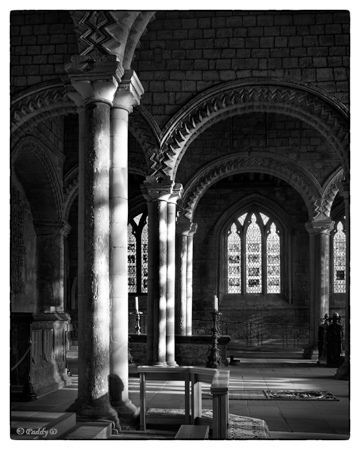
Galilee Chapel, Durham Cathedral
Take this image of the way in which the setting sun is lighting the Galilee Chapel of Durham Cathedral, for example. I don’t even need to see it – I can summon it to my mind’s eye at will – to remember that the evening felt special (it’s the only time I’ve ever taken photos in an ecclesiastical setting at sunset). And I've another favourite image from that time, of the sun bursting through St Cuthbert’s window, which will trigger the same memories. I can tell you more about the evening; about entering through the north-west porch; about the row of photographers, lined up at the west-end of the nave; there's so much to say. And, as I talk, you’ll hear all the emotion and passion in my voice that’s contained in two earlier pieces which I wrote about churches (HERE … and HERE …)
That’s the story – the invisible story – which is running in my mind, as soon as I see these images, or think about them. But in reality, the images only convey the visible story – they’re too literal. They give an accurate record of the scenes we saw, but display none of the richness of our experience.
And this is the essential question I’m now battling with. Is it enough to just tell the visible story – particularly when an image does it so well? Or do I want to tell the invisible one? Do I stay within my comfort zone, keep emotions at arm’s length and make cautious choices? – that’s what I feel is at risk, if I stay with the visible story? Or do I venture outside my comfort zone, embrace the emotional experience, and try to communicate the invisible story?
Certainly, that’s what my newly-emerging creative persona would like to try!
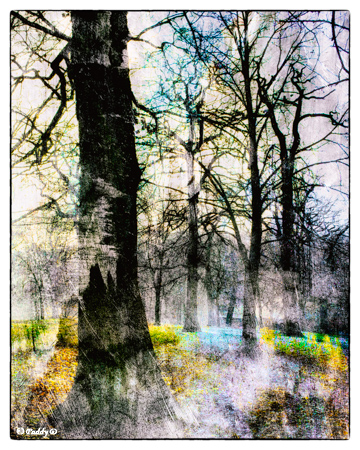
Untitled
Thinking back a few years to times before this pandemic, I’m minded of the early days of my woodland photography. My disappointment that the excitement and joyousness of our woodland walks was sadly missing from my images – and the analogous thinking (a.k.a. childlike playing in the sand pit) which led to the image above with its new visual interpretation, a new visual language. And I feel that the cycle is now repeating itself with my ecclesiastical images.
So, the answer to my question, ‘where next?’ is clearly signposted now. It’s about applying that same analogous thinking to my ecclesiastical studies; about finding the visual language I need to ensure that the finished images reflect my experience as strongly as they record the architecture, and then you’ll know that they “warm my heart each time I see them”.
What an enticing prospect.
Stay safe
Paddy
August 2020