What has photography ever done for me?
Digital Photography
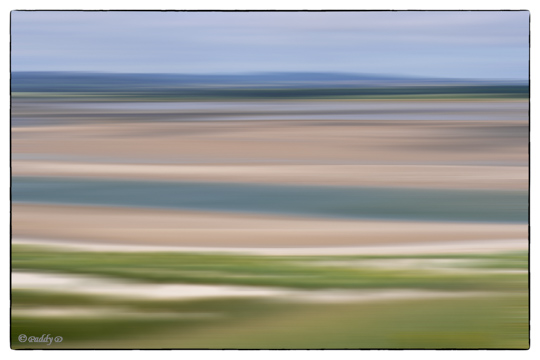
The Essence of Budle Bay
The colours of the bay are distilled using the
technique of Intentional Camera Movement
My break from photography extended until July 2004, and a holiday in Scotland where we saw beautiful sunsets. My cameras from the 70s and 80s were 250 miles away in a cupboard, so I bought a small, cheap camera – my first digital – and snapped away happily for two weeks. And I continued in the same mood for a few years – the camera was just for holidays again, as it had been in my childhood – with no thought of resuming the earlier style of photography.
But that changed in 2008 when I made the first (of many) very modest upgrades of my digital camera and embarked on the first (of many!) courses in learning how to use it properly.
I can’t remember exactly what the catalyst for this change had been – most likely a growing need to re-establish an area of interest and activity which was uniquely mine, post-engineering and post-sport. And that supposition links with the fact that I chose to do it in photography – an activity in which I’d already developed some ability, experience and confidence, and which reconnected me with a positive time in my life (rather than all the insecurities and uncertainties of learning to play a musical instrument from scratch, for example!) And photography abounds with guidelines and rules – so it felt more like a science than an art (at the beginning, anyway) – and as a consequence, I was pre-disposed to be a confident learner.
My memories of film-photography in the 70s and 80s were of relishing the challenge and stimulation of learning something new, and of enjoying it immensely. And, with the benefits of hindsight, I can see I was building foundations for a later time. And I’d say all the same things about the decade in which I got to grips with digital photography; except, of course, that I made the very sensible decision to learn from experts (rather than being self-taught). This culminated in a three-year mentoring program with Julia Anna Gospodarou – the best and most significant choice I ever made in my photographic life.
Compared with film/darkroom photography, I found digital photography an easier medium to learn in – it’s more responsive, more immediate – and it helped that I was semi-retired, that photography wasn’t competing against a day job for my time. There were also the wonders of the 21st century to help me – the wide range of high-quality material on the Internet. Yes, it was a good time to learn – and I made good use of it.
Another significant decision I made was in taking a short online course with Oxford University Continuing Education Department on the History of Art, arguing (correctly) that centuries of art must provide plenty from which I could learn and inform my photography. But it also changed my cultural life – we started visiting art galleries (which, until then, I believed belonged in a distant, alien, inaccessible art-world, having nothing in common with my ‘real’ world); we looked out for exhibitions; we saw paintings, photography, ceramics; I took drawing classes and workshops – got to know local artists Helen Thomas, David Lyon and Tony Wade. Next, my newly-energised curiosity sought out local history and I was poring over the old maps of Leeds. Yes, my photography was informed but so was I – more aware of a richer more rewarding life around me.
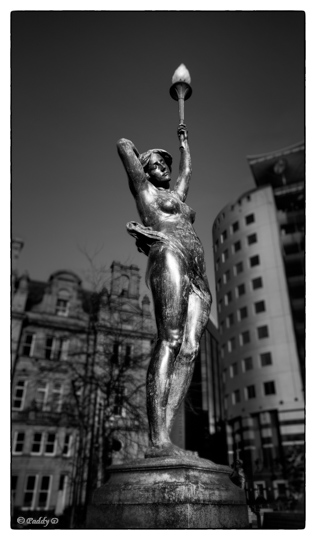
'Even' by Alfred Drury,
City Square, Leeds
I know she's a statue, but I admire her self-confidence
in standing stark naked, in the centre of the city
Thinking back to this period of my photography (and browsing through thousands of images) it’s easy to see both the similarities with the earlier phases and the developments – the way in which the similarities grew and progressed. But my notes also show something else – an additional strand that wasn’t evident the first time round – something I struggle to pinpoint. My notes relating to 'what digital photography has done for me' variously mention belonging, sense of place, sense of self, identity, confidence, expression. It’s all these things – and more – things I didn’t need from photography the first time round (probably because there was enough in the other spheres of my life to provide them). I’ve written about wellbeing – the green therapy of visiting gardens for my botanical studies and of bird therapy; about the emotional tranquillity and sanctuary of visiting churches for ecclesiastical studies; about mindfulness and therapeutic photography. The sense of healing.
But I’ve also identified a cautious trait in my work – that I have a habit of keeping emotionally invested photography at arm’s length. Whenever I begin to feel overwhelmed, I elect to withdraw to the comparative ‘safety’ of technical, analytic work which is driven by intellectual curiosity rather than emotional expression.
So I feel I’m on the threshold now. That my digital photography has established strong foundations for something more (just like the film-photography before it). And I’m minded of the observation that David duChemin made when he was recovering from a serious accident, that he could see the recovering-wounded standing somewhere between who they once were and who they were becoming.
I feel I’m in the same situation; that I’m on the cusp; that exciting, photographic opportunities await me, opportunities with the power to heal.
That’s what digital photography does for me.
P.S. You can find out more about my digital photography – the very long read! – HERE …