
Digital Photography and Botanical Studies
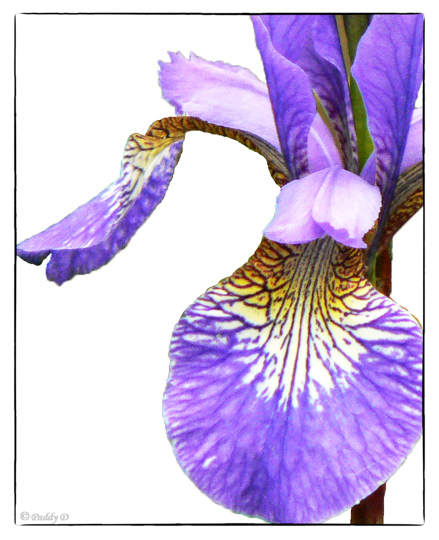
Untitled
From 2008 to 2014 my photography was knee-deep in flowers, something which caused me great confusion. And it’s an interesting measure of this continuing unease that I’ve chosen to tell you about it first, before anything positive about this period.
Obviously, flowers were a subject of choice – there was no external pressure or imperative – but it offended my 1970s, card-carrying, feminist self. It was so girly! I was also aware that the traditional art establishment had little respect for women flower-photographers – though I’m unsure which of those three nouns it held with most derision.
Eventually I formed an uneasy truce with my offended-persona, sufficient to immerse myself in the genre for six years, a truce grounded on me learning about its historical context; the unique learning opportunities it afforded me; the discovery of numerous male practitioners (in both art and photography); and by adopting the more accurate and appreciative title ‘botanical studies’ to replace the derogatory epithet of ‘just flowers’.
Interrupting myself, I’ve noticed that there’s something funny which keeps happening with this project (‘funny’ as in unexpected but delightful and valuable). Whenever I start to rush through an idea and imagine I can just tick it off and move on, it trips me up and says “Stop – this topic will be more rewarding if you take the time to make the issues explicit”. So, duly admonished, I’m giving my botanical studies the attention they deserve and I've taken time to fully browse through my images and my library of botanical art – particularly three lavishly illustrated (and weighty) books, ‘The Golden Age of Botanical Art’ by Martyn Rix amongst them.
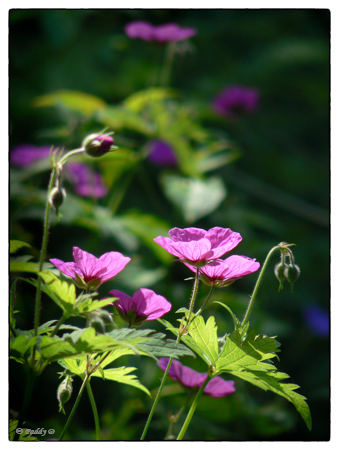
"It will be a long time before I take something as good as that again", I said.
But it wasn't!
Now, back on plot, and thinking about the basic question ‘what have botanical studies ever done for me?’ the first and most visible outcome is in the improvement my technical skills – although I ought to own up that I stumbled into this area of improvement. By accident, rather than design, the image above of cranesbill geraniums shows differential focus (the technique whereby the subject of an image is in sharp focus and appears distinctive, set apart from a softer, blurred background). And the comment I made on seeing the result is now a family joke – “it will be a long time before I take something as good as that again.”
But it wasn’t a long time. I soon found out how I’d achieved it – or more strictly, what accidental group of settings on the camera had achieved it – and the learning journey began. Before long I’d set up a tabletop studio to isolate and study the photography of individual flowers and I was acquiring even more technical skills – composition, lighting and portraiture – learning how to represent the character and qualities of a ‘sitter’ (albeit a botanical one rather than a human one).
My respect for botanical studies also increased when I started to look into its history, firstly reading that botanical illustration has had an important scientific role in herbals (from the time of Pliny); in recording the discoveries of journeys of exploration in China and the Americas etc; and in horticultural journals. Then finding out about the Victorian biologist and artist, Marianne North who travelled by canoe through the forests of Java and Borneo in search of orchids (disabusing any idea I had that botanical art was the purview of Victorian ladies, whiling away the hours as they waited for a suitable marriage). And the discovery of a large number of male artists (da Vinci included) and also highly respected photographers, both male and female, with botanical studies to their name (Ansel Adams, Roger Fenton, Robert Mapplethorpe and Imogen Cunningham). But it was tulips that piqued my interest most – both photographically and historically.
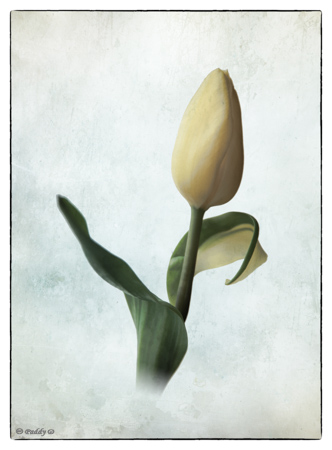
With the leaves telling their own story
Looking through my catalogue of flower photographs it’s clear I’m attracted by the shape and silhouette of the flower-head – some round, some elegantly long; the texture of the petals, especially as the flower ages; the way the petals nest together; how they curl over at the top – sometimes inwards, sometimes out; the stamen and the carpel peeping out of the top; the squirls and patterns in the colour; the curve of the leaves. Another quality I’m fascinated by (and photograph repeatedly) is that endearing way they have of relaxing into a vase. How they seem to shuffle and jostle amongst themselves and then, collectively, decide which one will settle where. If you take one from the vase there’s only one place you can put it back – back into its original location. Anywhere else looks alien.
A short burst of research on the internet shows I’m not alone in this tulip-obsession. At least two contemporary photographers have published tulip projects (John Blakemore, Ron van Dongen) and other well-known photographers have at least one tulip photo in their portfolio (Robert Mapplethorpe, Andre Kertesz); there are histories (Anna Pavord), historical novels (Philippa Gregory, Deborah Moggach) and academic research in history, botany and economics (Peter Garber, Ismail Yardimci).
So, it wasn’t just me!!
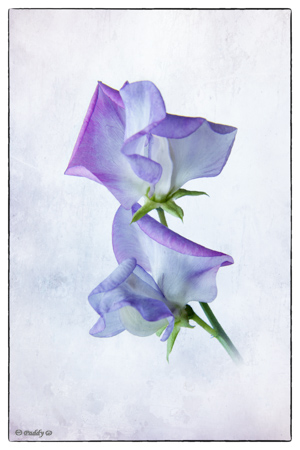
One I grew from seed
What surprises me most, looking back over my flower period, was that I was so busy fighting against the girliness of botanical photography, I overlooked the good it was doing me – its green therapy. We were visiting parks and gardens, looking out specifically for National Plant Collections and walled gardens; we went to the Harrogate Flower Show; and, under the supervision of well-trained horticulturalist friend, I started growing my own flower specimens – some from seed (sweet peas and welsh poppies), some from bulbs and tubers (dahlias, tulips and lilies). And I developed affection and respect for the lowly ones I’d nurtured, the sweet peas and poppies; photography allowed me to elevate them to the same grandeur as their imperious relatives, the sculptural looking ones, the dahlias and roses.
That’s what photography has done for me – well, it will, if I let it.