
Digital Photography and Certainty
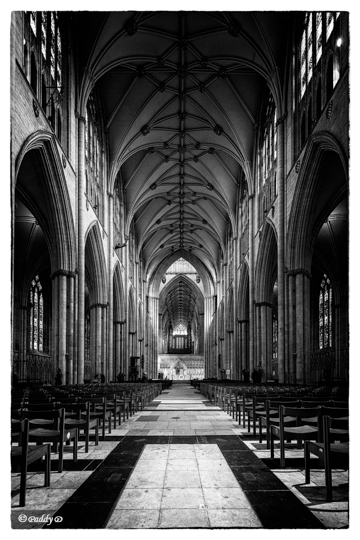
York Minster,
aka single point perspective
When I first started to learn digital photography, I was helped that it abounds with guidelines, ‘rules’ and how-to books. Later I enjoyed the freedom afforded by fine art photography and benefitted from the lateral thinking of my mentor, Julia Anna Gospodarou – but that was yet to come, some years in the future. At the beginning, it was the structured nature of the advice which helped me, providing a lot of material that my organised, scientific mind could adopt; there was a lot for me to hang onto.
It gave photography an aura of certainty. And gave me the belief that photography was accessible – more of a science than an art.
It helped too, that I’d learnt technical drawing at University, understanding perspective for example (single-point, two-point, even three-point perspective) and the way it creates a sense of depth, distance and three-dimensions in an image; that I wasn’t intimidated by the language; and that I’d used flow diagrams and schematics professionally, understanding the power of clear, unambiguous visual communication.
All in all, it meant I was predisposed to be a confident, independent learner of photography.
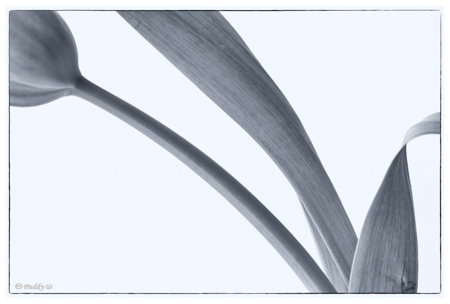
The composition of this image is based on lazy curves and negative space
Giving you some examples of the abundance of material I could learn from, we can start with composition; there are numerous different guides (which helped me position the subject within my image) based on thirds, the golden ratio, diagonals, triangles and even impossibly complex layouts.
In his book ‘The Painter’s Secret Geometry’ (1963) Charles Bouleau demonstrates the underlying geometric layout of works of art from the Middle Ages through to Jackson Pollock and Piet Mondrian – it’s a fascinating treatise, if you can cope with an overwhelming overload of information!
Then there are design guidelines for using leading lines; tackling images which are dominated by horizontal or vertical lines, diagonals or circles; guidelines for light and mood; for negative space, balance, rhythm, point of view; the Royal Photographic Society guidelines to achieve their distinctions. Soon guidelines would have guidelines – I was spoilt for choice!
Then I can check the tonal distribution of my photograph on the histogram; adopt the Rembrandt lighting scheme for portraiture; emulate my different tutors – photograph the same subject matter as them, in the same style as them; imitate classical art – the lazy curve of the beach in ‘The Shore (at Dymchurch)’ by Paul Nash is a particular favourite; subscribe to the philosophy, approach and methods of a particular photographer – there’s Michael Freeman for example who has written extensively on every aspect of camera craft, editing, design and vision (and includes flow diagrams in his books – I do love a good flow diagram!)
As I said there was plenty for me to adopt, emulate and follow – to feel certain about photography. And this ‘certainty’ path was a good one to follow at the start – it laid very strong foundations and provided me with a strong set of tools which, in later years, would allow me to make creative choices.
But the ‘certainty’ path had disadvantages too; it reinforced my belief that I would only ever be a technical photographer – albeit hopefully a good one – never an artistic one. And it allowed me to rely on such a strong technical approach that I ran the risk of becoming predictable and unoriginal.