
Digital Photography and Learning
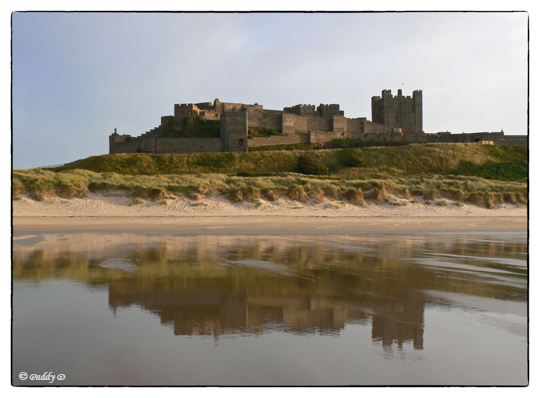
Bamburgh Castle
Much as I loved my early photography, the medium of film and the darkroom was a frustrating way to learn; it was slow – several weeks could elapse between me shooting the first photograph on a film and seeing it in print; it was restrictive – with only 24 or 36 shots on a film, each one felt precious, far too precious to waste on a speculative ‘try-it’ shot; it was easy to feel swamped in the darkroom – the more photographs I shot, the more films I had to develop and images to print; it was expensive – the more I shot, the more films and darkroom materials I had to buy. So digital photography was like a breath of fresh air, for its immediacy and the freedom.
I could ‘chimp’ the image as soon as I took it, to get a quick sense of the shapes and composition (‘chimping’ describes the way people look at the photo on the back of their camera and go “ooo, ooo, ooo” like a monkey). And then I could download all the images and review them properly as soon as I got back into the house. And there was a sense of freedom too; I could take one photo or a hundred, it didn’t matter – the cost didn’t change, and I wasn’t overwhelmed by the developing/printing.
The photographs I took up at Bamburgh clearly show the way my digital photography developed in just a few years; it gives a good record because we visited each year from 2007 to 2011. As well as being able to enjoy looking back over hundreds of photographs, I can see the transition from Bamburgh being just a holiday destination to being a valuable ‘schoolroom’ for me; from holiday ‘snaps’ of Lindisfarne, Seahouses and Bamburgh Castle in 2007, to concerted sets of images tackling different learning problems in 2009-11.
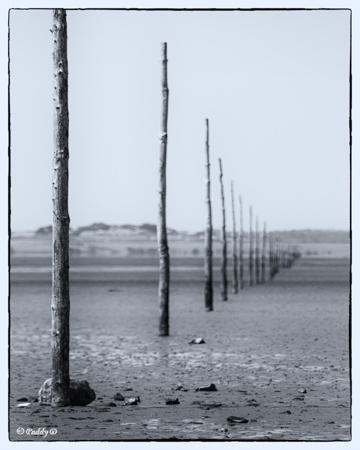
The Holy Island Causeway,
a study in perspective
You can see me working on a sense of scale – ensuring Bamburgh Castle looks the imposing size it is, not like a child’s toy; on movement – the way the position of a wave crest affects the dynamic of the image; the sense of depth – creating the illusion of 3D, by taking one’s view from the foreground through the middle ground to the background of an image; the position of the horizon and the way it changes the story – low down in the photograph it tells you that Bamburgh is a place of big skies – high up, Bamburgh is a place of endless beaches; practising the technique Gustave le Gray used in the 1850s to achieve tonal balance between the sky and sea; as well as other topics such as exposure, composition, perspective, reflections, mood and sun glare.
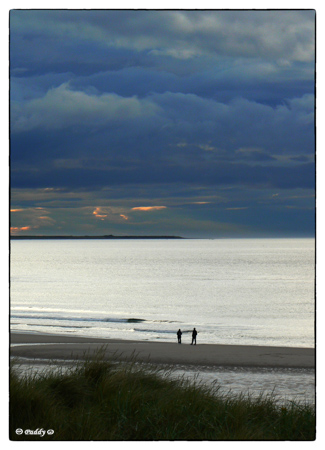
Bamburgh Beach,
after Gustave le Gray
Digital photography showed me that there was life after engineering – the opportunity to learn, to develop, feel challenged, to take pride in the way my learning was progressing and with it, my self‑confidence and assurance.