
Digital Photography and Not Seeing
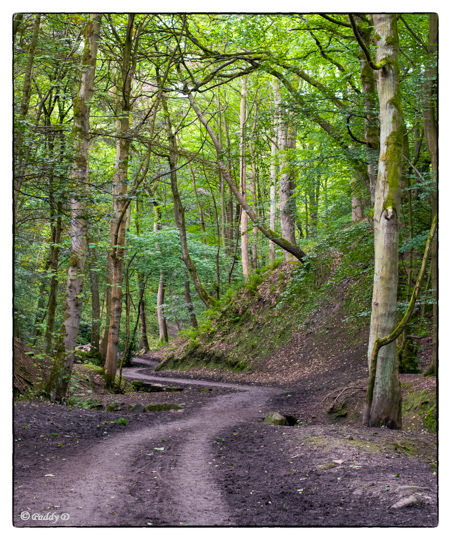
Great Heads Wood,
Roundhay Park
As I've already mentioned (HERE …) I see more when I’m carrying my camera – it acts as a physical prompt, encouraging me to look around and pay more attention to my surroundings. But, as I've been reviewing hundreds of images recently, I've noticed two things. Firstly, I've been surprised that the camera can still record things that I didn’t notice. Most recently it was a dog we passed while out walking which, according to the camera, was closely related to a wolf, although I simply hadn’t noticed it. Secondly, that seeing ‘more’ doesn’t ensure a never-ending, fresh supply of unique images – in fact, they can get quite predictable. In the woods, for example, I invariably capture an image of the path I’m walking on, another of sunlight through the branches, another of tree-trunks in silhouette etc. – my choice of images is getting very 'same-ey'.
So, as you might expect of me, I started to explore the physiological and psychological reasons why these things occur.
There’s also a third thought which is why, when I’m not carrying the camera, do I daydream through my visual life on autopilot, failing to see most of it?
And it seems that, simply, there’s just too much to see – to process and attend to. We watch out for danger and get attracted (or do I mean distracted?) by movement but, otherwise, we only pay attention to the things we’re interested in; we’re sadly inattentive to most of the visual scene around us. As photographer Guy Tal explains:
“The reason we miss a lot of what happens … is that awareness is a product of attention (i.e., you are aware of things you pay attention to, and unaware of things you don’t pay attention to), and attention is a scarce resource – we only have so much of it to go around. The more things you try to pay attention to, the less attention you will give each one …” The Mindful Photographer
So, it seems that I have no agenda of visual-interest when I leave the camera at home, no visual-anticipation of what to look out for, and hence I pay less attention to my surroundings. But, with a camera in hand, I pay attention to all the aspects which have the potential to make interesting images – I’m thinking, looking and seeing as a photographer.
But there is still too much to see – I have to reduce it, filter it somehow; and I do it by paying attention to a few regular, repeatable, now-familiar ideas – silhouettes, paths and sunlight – to the things which I’m currently the most interested in. And, while I’m focussing on those, the ‘wolf’ passes by unnoticed!
“The hardest thing of all to see is what is really there.” JA Baker, The Peregrine (1967)
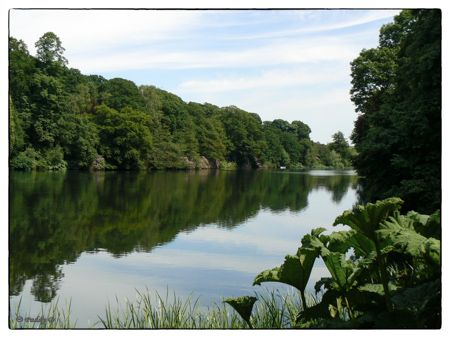
Harewood House, Leeds
So maybe it’s time to think about ways I can refresh my ‘seeing’. Perhaps retrace my ‘seeing-journey’ (which began in 2008 with an assignment in the OU photography course); perhaps set my own assignments for myself. Or adopt any of the 7-day, 30-day, year-long challenges which abound on the internet (to photograph something different and new each day). Or a 50-step challenge (a staccato walk, where you stop after every 50 steps and photograph something close to hand). Or better still, I can subscribe to a Mindful Photography Programme with Ruth Davey – to improve my wellbeing and refresh my ‘seeing’ at the same time. Win-win! (And her next online course starts on 4th October).
“Mindful photography is using our sight and a camera as an anchor to help us become more consciously aware of the present moment. It is experiencing the process of creating photographs in a non-judgmental, compassionate way.” Ruth Davey, 2017
So, excuse me if I stop writing now. It’s time for me to I pick up the camera – and to breathe more deeply of the air and the world around me.
That’s what photography can do for me.
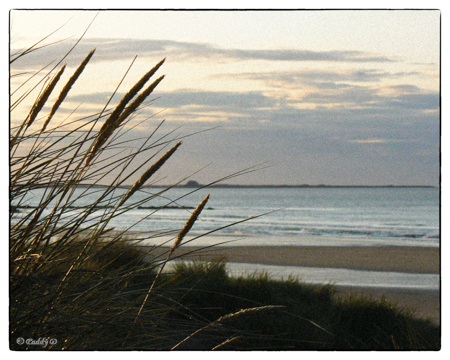
Lindisfarne Castle, from Bamburgh
Postscript: My most surprising example of ‘paying attention’ occurred at the drawing workshop I attended at the Yorkshire Sculpture Park, run by Tony Wade.
I was concentrating on sketching a man standing in an archway when Tony said, “you haven’t included the octopus, then?”
What octopus?
I guess he meant the much-larger-than-me, steel and concrete sculpture of an octopus covered in blue mosaics, which was partially restricting my view. That octopus!
Like the ‘wolf’, I didn’t see the octopus because I was paying attention to something else – looking more intently somewhere else.