
Digital Photography and Something Else
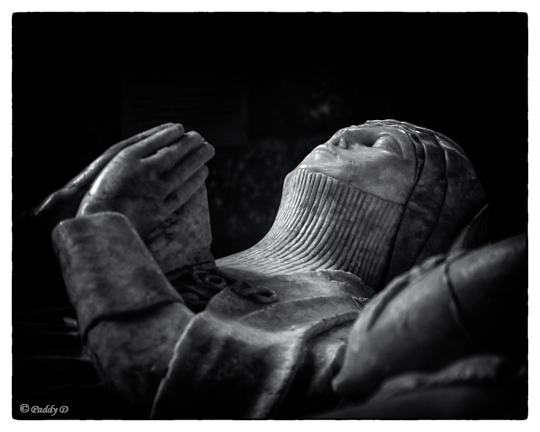
Effigy of Margaret Clarell in Harewood Church, Leeds
from 'Ian's Mates: People Like Us' series
When I started planning this section, it was called ‘Black and White.’ Then I changed it to ‘More About Learning,’ then ‘More About Learning in Black and White.’
I wanted to write about my monochrome photography because it had been such a significant presence in my work for over five years. But when I started to relate it to the basic question ‘what has it ever done for me?’ I was at a loss. Was it really about the medium? Or about the learning? Or maybe something else entirely was going on.
Trying to tease this issue out, I’ll start with the black and white aspect.
When I started my digital photography, it was all in colour and I persevered with it for several years. But, in 2013, I took a short online course in black and white with John Beardsworth, enjoying the opportunity to reconnect with my photography in the 70s/80s. It enabled me to make very striking images which felt clean and unambiguous. But in truth it was a very safe, unadventurous decision; with all the familiarity and comfort of meeting an old friend, I was happily inside my comfort zone.
Now, if my mysterious topic called ‘something else’ is actually about black and white, then I could further pursue its advantages/disadvantages. But maybe it lies in learning …
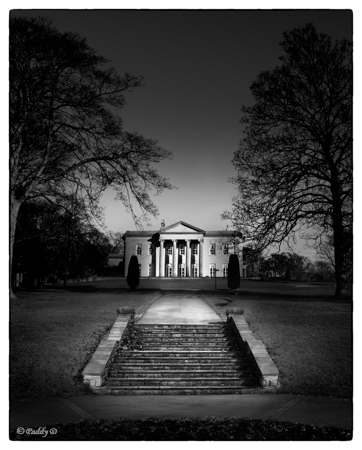
The Mansion,
Roundhay Park, Leeds
The decision to work in monochrome had a momentous outcome in terms of learning and my photographic growth; it led to me working with the black and white, architectural specialist Julia Anna Gospodarou – starting with six months of mentoring, the relationship extended into a three-year programme.
A teacher friend tweeted recently about the ability of good teaching to create potential rather than simply maximise innate potential; and that’s my experience from working with Julia. Her tutoring programme differed from every other photography course I’d ever taken; these had concentrated on technique and camera-craft. I learnt a lot about ‘how’ on those earlier courses – how to take better photos; better flower photos; better close-ups; better black and white – and this ‘better-ness’ was also ever-present with Julia. But the difference was that her emphasis on technical quality was implicit, not the main goal. She encouraged, informed and helped me to focus on the art, not ‘just’ on photography; on ‘why’ and ‘what’ – as arguably more important than ‘how’. And so I explored the emotional and expressive issues of vision – what am I feeling? – what do I want to share? – questions I'd never addressed before.
Looking back through my images from this period I can’t see much evidence of this deeper, more emotional, artistic approach. But the seeds had been planted in my mind; they’d been watered and germinated. And I’m sure it helped that I was working in black and white – the long established, innate confidence I have in the medium provided a firm footing while I was absorbing and processing more and more of the new, artistic ideas.
Strictly, I think it was premature to claim that I’d arrived at the point where I was living, thinking, breathing and seeing as a photographer; premature too, to be discussing my credentials as an artist. But I know I was starting to imagine it had happened/was happening – that there could be more to my work than simply being a technician with technical competence.
And that, I believe, is the elusive ‘something else’ I want to share with you – it’s about the place I was reaching, the artistic door which was opening.
Misquoting David duChemin, ‘I was on the cusp of who I once was, and who I might become.’
That’s what digital photography has done for me.
Postscript: When David duChemin was recovering from a serious accident he wrote “each day I walk laps in the gym, beside others, all wrestling with a piece of the puzzle, something standing between who they once were and who they are becoming”