
Fine art photography is about what exactly?
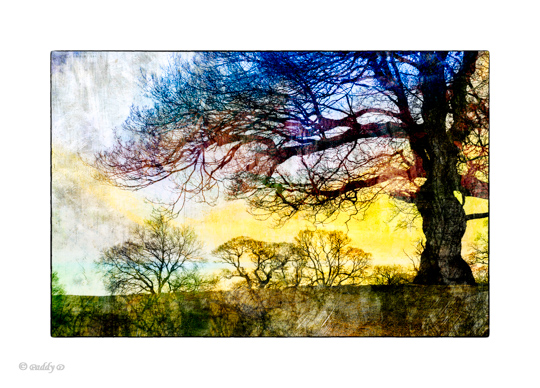
Uncertain Times II
I’d been working on this section about fine art photography for almost two weeks when it occurred to me to ask myself:
Am I completely clear what I mean by fine art photography?
And it took another 24 hours before I remembered that I’d answered this question last year.
We had been walking through the woods in Breary Marsh when we saw a shattered tree stump and flooded ditches which were evocative of war art we'd seen of the 1914-18 battlefields. So I tried to emulate Singer Sargent and Nash when I worked on the image to reflect this – to produce a 'fine art' version of the scene. And, as a result, I decided that fine art photography is an 'interpretation' (perhaps because of the historical association, I adopted the historical terminology).
I wrote about it in a piece entitled 'Rosetta Stone' (HERE …)
So yes, I thought, I am completely clear. For me, a fine art photograph is an interpretation.
Although I knew the answer (or thought I did), I sought confirmation from Google. And I got a range of answers from the totally useless (it's ‘intended for wall art’) to the incredibly useful:
‘creating something that previously only lived in your mind, as opposed to simply capturing what you see'
‘the goal of fine art photography is to express an idea, a message or an emotion.’
And these wider explanations have helped me make better sense of the different ideas that have come to the surface as I’ve been exploring ‘what has fine art photography ever done for me?’
Firstly, I realise that seeing it as an ‘interpretation’ is far too narrow a definition and that finding a better one (wider, more descriptive) might help me in my lockdown-quest i.e. to make the benefits of my photography more explicit and hence more beneficial.
Secondly, the fact that Google is awash with definitions – some similar, many different – makes it clear that the term 'fine art photography' means all things to all men (and women!); and even the definitions I considered useless must have made sense to someone. Every photographer will have their own definition, based on their own unique 'life lived', their own experiences, their own views, their own EQ (emotional intelligence).
Hence I also understand that the way I'm explaining it – redefining it – is singularly mine:
My fine art photography always begins with a story.
If I have the chance to share an image with you, I'll likely start by telling you that "when I first captured this image I was minded of ..." and I'll continue to tell you about 'being there' – my thoughts and my ideas as I stood before the scene; memories that had been triggered, my feelings, emotions – namely things which are sitting in my mind.
These aspects are always connected with the subject of the image – i.e. are associated with the version I captured on-camera – but are not explicitly visible there.
Thus, the subsequent fine art version of the image is my attempt to make the invisible, visible; to express feelings which, otherwise, remain internalised. I continue to share the same story with you but, this time, through the image alone, using visual language.
Wow – no wonder I had a working-definition of fine art photography as an 'interpretation'. It's so much more economical!